
Google Pixel 10 Pro in 2026: Still Worth It at $749?

The Google Pixel 10 Pro is a 6.3-inch Android flagship built around Google’s Tensor G5 chip, a 50MP triple camera with 100x Pro Res Zoom, and seven years of software updates. It launched at $999 in August 2025 and now sells for around $749. Its successor starts at $1,099 with less base RAM. That combination is the entire story of this phone in 2026, and it is why I am writing about a last-generation device instead of the shiny new one.
Here is my honest position after a year of reviews, lab tests, and price tracking.
Most people shopping for a flagship Android phone right now should not buy the newest thing.
They should buy this one. Let me show you why.
Why the Google Pixel 10 Pro Matters More in 2026 Than It Did at Launch
Timing rewrote this phone’s value proposition. At $999, the Google Pixel 10 Pro fought the Samsung Galaxy S25 and the iPhone on level pricing, and reviewers were lukewarm. At $749, it competes against upper mid-rangers while carrying genuine flagship silicon. That is not a small shift. It is a different phone in the buyer’s mind, which means most Pixel 10 Pro review coverage from launch week is now actively misleading if you read it as purchase advice today.
Look at what the discounted price actually buys.
< cite index=”14-1″>The custom Tensor G5, 16GB of RAM, seven years of software support, Qi2 magnetic wireless charging, a triple camera system with Gorilla Glass Victus 2, and a free year of Google AI Pro.</cite> Droid-Life said it cleanly: $749 is a fundamentally different conversation than $999.
The discounting has been relentless, too. < cite index=”8-1″>By June 2026 the phone sat at $250 off, or $749 for the 128GB model, with the same discount on 256GB and 512GB versions.</cite> Android Central tracked Amazon pushing $300 off as retailers cleared stock.
Price Timeline at a Glance
| Model / Timing | Storage | Price | What Changed |
|---|---|---|---|
| Pixel 10 Pro, Aug 2025 launch | 128GB | $999 | Original MSRP |
| Pixel 10 Pro, mid-2026 | 128GB | $749 | Steady $250 discount |
| Pixel 10 Pro, July 2026 peak deal | 128GB | ~$699 | $300 off pre-Pixel 11 |
| Pixel 11 Pro, Aug 2026 launch | 256GB | $1,099 | 128GB tier removed entirely |
< cite index=”28-1″>Confirmed pricing from the August 12 event: $899 for the Pixel 11, $1,099 for the Pixel 11 Pro, $1,299 for the Pixel 11 Pro XL, and $1,899 for the Pixel 11 Pro Fold, with the whole lineup shipping August 20.</cite>
So the real question is not whether this phone deserved a grand. It is whether the Google Pixel 10 Pro price today beats a successor asking $350 more than the street price of the outgoing model.
I think it does, comfortably. Here is the evidence.
Google Pixel 10 Pro Specs vs the Rest of the Lineup
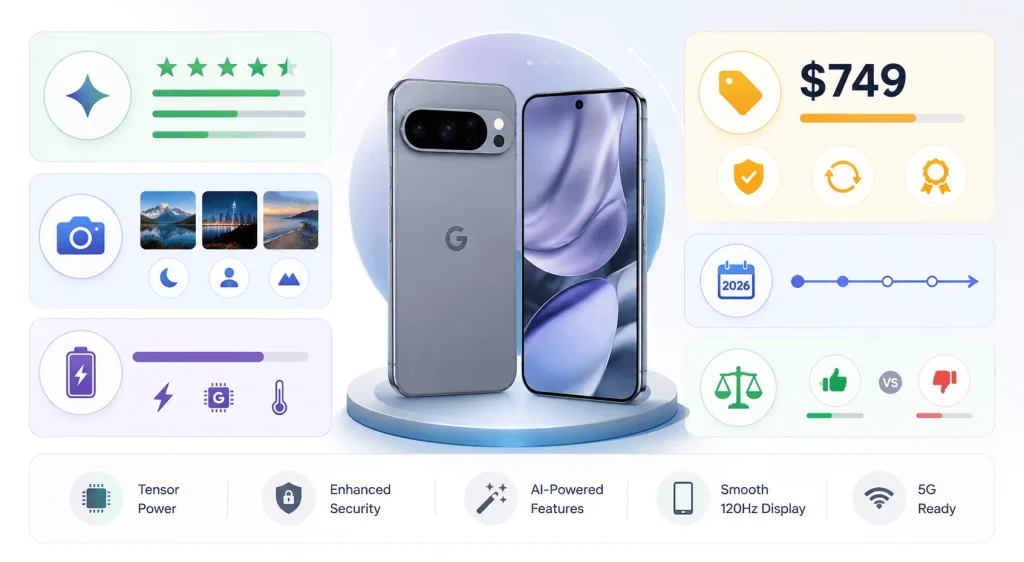
The hardware sheet is flagship-grade with no asterisks. < cite index=”24-1″>You get a 6.3-inch LTPO OLED at 120Hz with 3,300 nits peak brightness, the 3nm Tensor G5, 16GB of RAM, a triple camera of 50MP main, 48MP periscope telephoto and 48MP ultrawide, storage to 1TB, a 4,870mAh battery, IP68, 8K video, Wi-Fi 7 and Bluetooth 6.0.</cite> Nothing there is a mid-range part sneaking into a premium chassis. Below is how the three siblings actually compare, because the differences are narrower than Google’s marketing suggests.
| Feature | Pixel 10 | Pixel 10 Pro | Pixel 10 Pro XL |
|---|---|---|---|
| Display | 6.3″ OLED | 6.3″ LTPO OLED | 6.8″ LTPO OLED |
| RAM | 12GB | 16GB | 16GB |
| Main camera | 48MP | 50MP | 50MP |
| Telephoto | 5x optical | 48MP periscope | 48MP periscope |
| 100x Pro Res Zoom | ❌ | ✅ | ✅ |
| Battery | 4,970mAh | 4,870mAh | 5,200mAh |
| Wired charging | 29W | 29W | 39W |
| Qi2 magnetic charging | ✅ | ✅ | ✅ |
| 128GB option | ✅ | ✅ | ❌ |
Two details deserve separate billing.
< cite index=”6-1″>The selfie camera is 42MP, and charging runs 29W wired plus 15W Qi2 wireless.</cite> Charging speed is the one spec where rivals genuinely embarrass Google, and I will not pretend otherwise. < cite index=”42-1″>GSMArena measured the smaller Pro hitting close to its promised 55% in 30 minutes, while the XL, rated for 45W, reached 64% against a claimed 70%.</cite>
Build quality is where the money went. < cite index=”2-1″>The frame is aluminium with Gorilla Glass Victus 2 front and back, in Moonstone, Jade, Porcelain and Obsidian.</cite> Jade is the one strangers comment on.
The Display Is the Underrated Part
Screen quality gets buried in spec sheets, but it is the thing your hands touch for six hours a day. The Super Actua display here is an LTPO panel, so the refresh rate drops when content is static and ramps to 120Hz when you scroll. That matters more for endurance than for smoothness.
Lab testing tempers the brightness marketing, though. < cite index=”40-1″>GSMArena recorded 2,351 nits with adaptive brightness on a 75% lit area, essentially matching the Pixel 9 Pro,</cite> so the 3,300-nit figure applies to small highlight areas rather than the whole panel.
Outdoors in summer sun, it is still excellent.
Compact Flagship Is a Real Category Again
The 6.3-inch footprint deserves attention because so few premium Android phones offer it anymore. Droid-Life’s read matches mine: < cite index=”8-1″>the smaller Pro suits most people, especially anyone scrolling all day who still wants a hand free.</cite>
If you have been pushed into a 6.8-inch slab because that is where good cameras live, this solves a problem you may have stopped complaining about.
Pixel 10 Pro Battery Life: What Testing Actually Shows
Expect four to five hours of screen-on time in normal use, with the smaller Pro outperforming the larger XL. That inversion surprised everyone. Android Authority’s team testing found < cite index=”39-1″>the XL struggled to pass four hours of screen-on time while the standard Pixel 10 and Pixel 10 Pro managed closer to five, or a little more with lighter use.</cite>
Real-world reviewer data lines up. Droid-Life reported that < cite index=”38-1″>on the smaller Pixel 10 Pro, a typical 7AM to 11PM day produced three to four hours of screen time with 30% remaining.</cite>
Against direct rivals it holds up better than the modest capacity suggests. < cite index=”44-1″>In a controlled 200-nit test alternating video recording, social apps, YouTube and gaming, the Pixel 10 Pro lasted 7 hours and 1 minute, beating the iPhone 16 Pro at 6 hours 15 minutes and the Galaxy S25 five minutes behind that.</cite>
One caveat worth knowing. < cite index=”40-1″>GSMArena believes Google used conventional graphite anodes rather than silicon-carbon,</cite> which is why capacity stayed modest while competitors grew.
Tensor G5: The Chip Story Nobody Explained Well
Google switched foundries with this generation, and that is the most consequential change under the hood. < cite index=”19-1″>The Tensor G5 is Google’s first TSMC-fabricated Tensor, replacing designs derived from Samsung’s Exynos foundry.</cite> Counterpoint Research framed it as the moment Tensor became Google’s own silicon rather than a modified off-the-shelf part.
The performance claims are specific. < cite index=”20-1″>Google says the G5 is 34 percent faster than the G4 on CPU with a TPU 60 percent faster at AI tasks, letting the newest Gemini Nano run entirely on-device without connectivity.</cite> Engadget confirmed that offline generative AI genuinely works here.
If you want the wider context on how on-device models differ from cloud-based ones, our guide to generative AI breaks down the architecture in plain language.
Now the part I want you to hear.
Raw benchmarks are not this chip’s strength. MobileSyrup was blunt: < cite index=”21-1″>everyday speed across AI features and app launches was fine, but benchmarking results were disappointing.</cite>
That trade was deliberate. Google optimized for on-device AI throughput and sustained efficiency over peak scores.
Pro Res Zoom and the 100x Question
The telephoto system is the single strongest reason to pick the Pro over the base model. < cite index=”23-1″>The updated architecture delivers 10x optical quality and 20x super-resolution zoom, then reaches 100x professional resolution zoom with AI assistance, a workload so heavy that only the Pro has the processing bandwidth for it.</cite>
Results are startling. They also raise a question few reviews answer honestly.
PhoneArena asked it directly: < cite index=”2-1″>the AI sharpens the existing image and creates pixels from scratch with zero information from the sensor and the reality it is supposed to capture, which invites the question of when a photo stops being a photo.</cite>
My rule: use 100x to read a street sign, not to document anything you need to be true.
Camera Coach splits people. Business Standard found that < cite index=”18-1″>composition advice is useful but limited to static frames, and in fast scenes or with moving subjects it often causes missed moments.</cite> The same review landed a point that stuck with me: < cite index=”18-1″>imaging progress was minimal because the Pixel 10 Pro reuses the sensors introduced with the Pixel 9 Pro.</cite>
So the computational photography improved. The hardware collecting the light did not.
Magic Cue: Brilliant or Broken, Depending Who You Ask
Reviews genuinely contradict each other on this feature, so I will give you both sides instead of picking the convenient one.
The optimistic case, from Engadget: < cite index=”20-1″>with permission, Gemini reads your screenshots, calendar and Gmail, then surfaces the venue email address your friend needs or nudges your calendar when someone asks about weekend plans, marked with a rainbow aura that has become visual shorthand for AI.</cite>
The pessimistic case is harsher. BigGo’s testing found that < cite index=”24-1″>in organic use the assistant rarely surfaced anything meaningful, and when asked for an event address stored in Google Calendar it returned the wrong neighbourhood instead of the actual venue.</cite>
Both are true. Magic Cue shines when your Google account is dense with structured data and you live in Gmail and Calendar. It does close to nothing if you do not.
Worth noting for upgraders: < cite index=”31-1″>Google’s newer lineup pushes toward agentic tasks like ordering groceries or booking rides, which 9to5Google describes as a large jump from Magic Cue, though Magic Cue itself is not going away.</cite>
Should You Buy the Google Pixel 10 Pro or the Pixel 11 Pro?
Buy the older one in most cases, and the RAM situation is the reason people are missing. < cite index=”31-1″>The Pixel 11 Pro moves to Tensor G6 with 50% more TPU power, paired with 12GB of RAM as the baseline across the series, up to 16GB but down from last year at the bottom tier.</cite>
Read that again.
The discounted Google Pixel 10 Pro ships with 16GB standard. The newer Pro starts at 12GB and costs $350 more at street prices. For a phone sold on on-device AI, memory is not a footnote.
Here is my step-by-step decision process.
Step 1: Check your current phone’s battery health. Above 80% capacity on a Pixel 9 Pro? Skip this generation. The sensor carryover means your camera is nearly identical.
Step 2: Pick your size. Want compact? The standard Pro is your only premium option. Want maximum screen? < cite index=”6-1″>The XL brings 6.8 inches, 5,200mAh and 39W wired charging,</cite> though its endurance tested worse.
Step 3: Set a price alert at $749 or below. Track Android Central’s deals coverage monthly. Never pay list price for a phone in its final retail quarter.
Step 4: Choose storage deliberately. < cite index=”28-1″>The 128GB tier is gone from the current generation entirely.</cite> If you shoot 8K or keep offline libraries, 256GB is your floor.
Step 5: Confirm the support window. Seven years from August 2025 means updates into 2032, longer than most people keep a phone. If you’re cross-shopping platforms, compare it against Apple’s flagship in our iPhone 16 Pro Max guide before you commit.
Who Should Skip This Phone
- Fast-charging obsessives. 29W wired is genuinely behind the market.
- Competitive mobile gamers. Benchmark performance trails Snapdragon flagships.
- Anyone outside Google’s ecosystem. Half the value is switched off by default.
- Heavy screen-time users. Four to five hours of screen-on time is adequate, not class-leading.
- Buyers who need years-out battery health. Android Authority raised concerns about degradation across a seven-year support window.
Everyone else should look hard at the discount. If you’re weighing whether to wait for a newer release instead, our iPhone 17 launch guide covers the same wait-or-buy calculation from the Apple side, and the AirPods Pro guide is worth a look if you’re building out audio to match.
Frequently Asked Questions
Is the Google Pixel 10 Pro still worth buying in 2026?
Yes, especially discounted. You get current-generation silicon, a full flagship camera, 16GB of RAM, and software support through 2032 for less than many mid-rangers cost new.
How much should I pay for a Google Pixel 10 Pro right now?
Target $749 or below for 128GB. < cite index=”8-1″>That price recurred throughout 2026,</cite> so paying more usually means you moved too fast.
How long does the Pixel 10 Pro battery last?
Roughly four to five hours of screen-on time daily. < cite index=”44-1″>In controlled testing it ran 7 hours 1 minute, ahead of the iPhone 16 Pro and Galaxy S25.</cite>
Does the Pixel 10 Pro support Qi2 magnetic accessories?
Yes. Qi2 magnetic wireless charging at 15W works with Pixelsnap cases, wallets, power banks and car mounts without an adapter.
How long will the Pixel 10 Pro receive updates?
Seven years from its August 2025 launch, so security and OS updates run into 2032.
Does Pro Res Zoom actually work at 100x?
It produces legible, usable images, but it generates detail the sensor never captured. Treat it as convenience, not documentation.
What is the difference between the Pixel 10 and Pixel 10 Pro?
RAM and cameras. < cite index=”5-1″>The base model has 12GB against the Pro’s 16GB,</cite> and only the Pro handles 100x zoom.
Is Magic Cue worth enabling?
Only if you use Gmail and Calendar heavily. Its usefulness scales with how much of your life already lives inside Google.
I would rather own a discounted flagship with more RAM and seven years of updates than a new phone at full price offering incremental gains. If that logic tracks for you, set your alert and move before remaining stock disappears.
Final Verdict: Is the Google Pixel 10 Pro the Smart Buy in 2026?
The Google Pixel 10 Pro is the best-value flagship Android phone available right now, and the math is not close. At roughly $749, you get 16GB of RAM, a full triple-camera system with 100x zoom, Qi2 magnetic charging, and software updates running through 2032. Its successor asks $1,099 and starts with less memory.
That gap will not last. Retailers are clearing the remaining stock, and once it goes, the value case goes with it.
So set a price alert, decide between the compact Pro and the larger XL, and buy before the inventory dries up. If you want the newer option side by side, our Pixel 11 Pro breakdown covers what your extra $350 actually buys.