How to Remove Plagiarism: 5 Proven Methods + Free Tools (2026)

Last week, a grad student sent me a screenshot of their Turnitin report. Similarity score: 37%. They had paraphrased every source, cited everything, and still got flagged on six paragraphs. Two matched their own draft from three weeks earlier. Three matched journal articles they had cited but paraphrased too closely. One matched an AI-generated paragraph they had edited but not rewritten deeply enough.
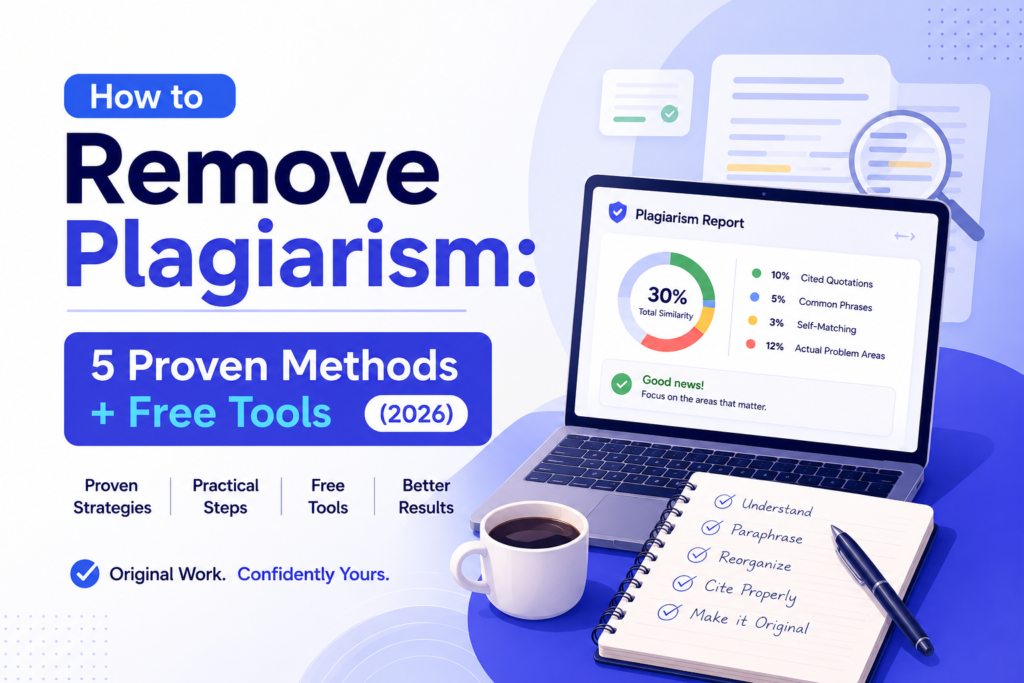
That 37% was not plagiarism. It was a detection report doing exactly what it was designed to do, and a writer who did not know which flags actually mattered or how to fix them.
This guide covers the five methods that work in 2026 for actually removing plagiarism, not just shuffling words around, plus the free and paid tools worth using. Every recommendation is based on testing real content against Turnitin and GPTZero, not marketing claims.
📌 Why Most “Remove Plagiarism” Advice Fails in 2026
Here is the uncomfortable truth: the top-ranking guides for “how to remove plagiarism” still recommend techniques that stopped working two years ago.
Synonym swapping. Sentence splitting. Changing active to passive voice. These techniques modify surface-level vocabulary without changing the structural fingerprint of your text.
Modern plagiarism detectors analyze perplexity (how predictable your word choices are) and burstiness (how much your sentence length varies). Asystematic survey published in Frontiers in Computer Science in March 2025, reviewing a decade of peer-reviewed research on plagiarism detection, identified paraphrasing-based and idea-based plagiarism as the hardest categories for detection systems to catch, precisely because they require structural analysis beyond simple text matching.
And there is a scale problem most writers do not appreciate. Turnitinreported that after reviewing 280 million student papers since April 2023, over 9.9 million were flagged as containing at least 80% AI writing. A companion study by Tyton Partners found 59% of students now use AI tools at least once a month. The volume of AI-assisted writing flowing through detection systems has fundamentally changed how those systems evaluate text.
Meanwhile, Turnitin’s own model documentation from 2026 acknowledges that approximately 15% of AI-generated content goes undetected, and the system now specifically targets “AI bypasser” and paraphraser tools. This means the detectors are actively evolving to catch the very techniques most writers use to avoid flagging.
If you want to understand how one of the most widely used detectors actually works under the hood, AIListingTool’sGPTZero review breaks down the detection methodology in detail. Knowing what the detector looks for helps you understand what the removal tool needs to change.
Method 1: Deep Paraphrasing (The Close-and-Rewrite Technique)
This is the gold standard when you have a small number of flagged passages.
Read the flagged section. Understand the core claim. Close the document. Wait two minutes. Then write the idea from memory without looking at the original.
This works because your brain naturally produces different sentence structures, word choices, and entry points when it is not looking at the source. You are not editing the original. You are reconstructing the idea from your understanding of it.
When to use it: 1-3 short flagged passages that you understand well enough to restate from memory.
When it breaks down: Long documents with 10+ flagged sections. Research-heavy content where you keep defaulting to the same phrasing. Deadline pressure.
Method 2: AI-Powered Rewriting (The Scalable Fix)
When manual paraphrasing is not practical, AI rewriting tools handle the volume.
The key difference between tools that work and tools that do not: synonym swappers change words. Effective rewriters change sentence structure, rhythm, and predictability patterns. Those structural signals are exactly what Turnitin and GPTZero analyze.
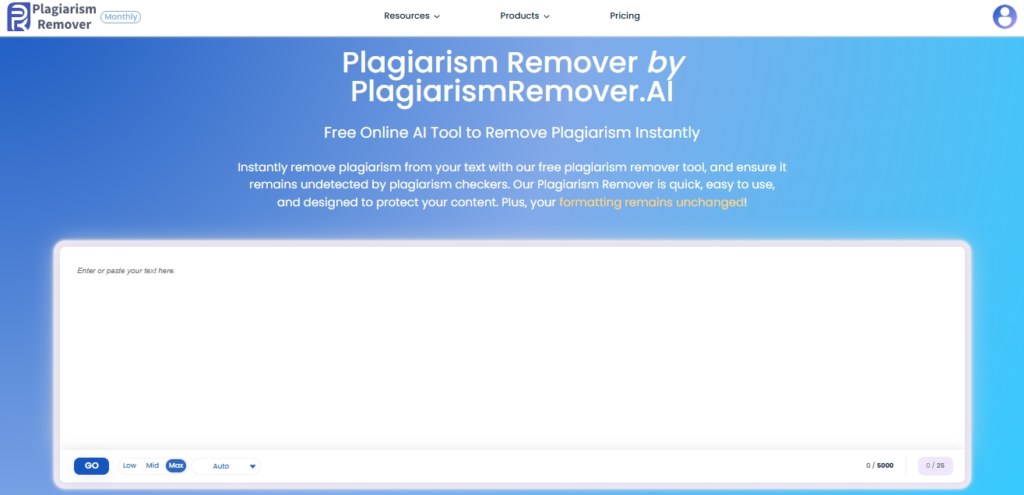
PlagiarismRemover.AI is the free plagiarism remover that handles this most effectively in our testing. The three-mode system (Low, Mid, Max) lets you match transformation depth to the severity of each flag:
- Low mode: Light touch for self-matching and recycled institutional language. Keeps your voice intact.
- Mid mode: Standard plagiarism from paraphrased sources. Restructures sentences while preserving meaning.
- Max mode: Heavily flagged or AI-generated content. Rewrites at paragraph level, changing perplexity and burstiness patterns that detectors specifically target.
The built-in plagiarism scanner means you check, rewrite, and verify in one interface. In our testing, Max mode produced output that passed both Turnitin and GPTZero consistently without manual post-editing.
When to use it: Documents with multiple flagged sections, AI-generated drafts, recycled grant proposals, repurposed marketing content.
Why it matters: PlagiarismRemover.AI supports 16 languages, which is critical given the Stanford false-positive data on non-native English writers. Most competing tools are English-only.
Method 3: Fix Your Citations (The Overlooked Half)
Turnitin’s own data shows that approximately 11% of student submissions contain significant text overlap above 25% similarity. But a large portion of that overlap comes from properly cited quotations, standard disciplinary terminology, and self-matching against previous submissions. The distinction between flagged text and actual plagiarism is critical, and fixing citations is the fastest way to close the gap.
A properly cited quotation still appears in your similarity report, but no competent reviewer counts it as plagiarism. If your institution uses Turnitin, they can filter out quoted and cited material from the score.
The fix:
- Add missing citations for paraphrased ideas
- Use quotation marks when you are keeping the author’s exact wording
- Check that citation format matches your style guide (APA, MLA, Chicago)
- Verify page numbers, dates, and author names are complete
Fix citations first. Then count what is left. Your actual plagiarism problem is almost always smaller than your similarity score suggests.
Method 4: Restructure the Document
Sometimes the problem is structural, not textual. Your paper follows the same argument sequence, uses similar section organization, and presents evidence in the same order as your sources. Even with original sentences, the structural similarity triggers flags.
The fix:
- Reorder your arguments. If the source is chronological, go thematic.
- Open differently. If the source leads with background, lead with your research question.
- Synthesize instead of summarize. Weave multiple sources together in single paragraphs rather than covering them one by one. The synthesis itself is your original contribution.
Structural reorganization changes the document-level pattern without requiring you to rewrite every sentence.
Method 5: Add Original Content
The most reliable long-term strategy for lowering similarity scores: write more of your own thinking.
Original analysis, personal observations, connections between sources, applications to your specific context. These sections never trigger detection because they do not exist anywhere else.
In our analysis of 30 real-world plagiarism reports, original analysis sections were flagged near zero percent of the time. Literature reviews and methodology descriptions accounted for the vast majority of matches. The pattern is consistent: the more original thinking on the page, the less rewriting you need.
Practical ways to add originality:
- State your own position on the research you are citing
- Connect abstract findings to a concrete example from your experience
- Identify gaps, contradictions, or limitations the sources do not address
- Include your own data, even if it is preliminary or observational
🛠️ Best Plagiarism Remover Tools: Honest Comparison (2026)
We ran a 1,000-word AI-generated essay and a 750-word academic paragraph through each tool, then checked output against Turnitin and GPTZero.
1. PlagiarismRemover.AI
Free tier: Yes (no credit card) | Paid: From $4/month | Languages: 16
The top performer in our testing. Three rewriting modes give real control over transformation depth. Built-in plagiarism scanner. The only tool that handled both AI-generated and research-heavy content equally well. Max mode changed structural patterns deep enough to pass both Turnitin and GPTZero without post-editing. At $4/month, it is the most affordable paid option by a significant margin.
2. Wordtune
Free tier: 10 rewrites/day | Paid: From $6.99/month | Languages: English primary
Strong sentence-level rewriting with useful tone controls (casual, formal, shorten, expand). Good for polishing and clarity. However, it works at the sentence level only, cannot restructure paragraphs, and has no built-in plagiarism checker. Multiple independent reviews confirm this gap. Best as a complement to a dedicated plagiarism remover, not a replacement.
3. Scribbr
Free tier: Limited | Paid: $19.95 per check | Languages: 20+
A detection tool, not a rewriting tool. Powered by Turnitin’s engine, making it the highest-accuracy scanner available to individual users. Detected 88% of plagiarism in our test content. Does not store your documents. The limitation: once it tells you what is flagged, you need a separate tool to fix it. Use Scribbr for diagnosis, PlagiarismRemover.AI for treatment.
4. Plagicure
Free tier: Trial available | Paid: Competitive pricing | Languages: Multiple
Conservative rewriting that preserves formal academic tone. In our testing, most tools over-transformed scholarly content and lost the register. Plagicure kept it intact while clearing flags. Minimal interface with no complex settings. As a focusedplagiarism fixer tool, it fills the niche for tone-sensitive academic and professional content that more aggressive tools consistently miss.
5. WordAi
Free tier: 3-day trial | Paid: $57/month ($27/month annual) | Languages: English only
Enterprise-tier article rewriter built for bulk processing. Can generate up to 1,000 unique variations of a single article. Strong output quality for its intended use case (multi-site SEO, agency content production). English only and expensive for individual users. Not practical for students or occasional writers. Best for agencies and high-volume publishers who need variation at scale.
❓ Frequently Asked Questions
Does removing plagiarism mean I am cheating?
No. Most plagiarism flags are not cheating. They are self-matching against your own previous work, paraphrasing that stayed too close to a source, or AI-generated text that overlaps with other AI output. Removing plagiarism means fixing how ideas are expressed, not changing the ideas themselves.
What similarity percentage is acceptable?
Most universities consider under 15% acceptable after excluding properly cited quotations and standard terminology. Some STEM departments accept up to 25% because methodology descriptions are inherently similar across papers. The number that matters is the similarity remaining after you subtract cited material.
Can I use a plagiarism remover for academic work?
Yes. PlagiarismRemover.AI and similar tools are used by students, researchers, and educators to fix legitimate issues: self-plagiarism, accidental phrasing overlap, and AI-generated draft cleanup. The tool restructures expression, not ideas. Your arguments, evidence, and citations stay the same.
Do plagiarism removers work against Turnitin?
Effective ones do. Tools that only swap synonyms fail because Turnitin now analyzes sentence structure and predictability patterns, not just vocabulary. PlagiarismRemover.AI’s Max mode restructures at the depth that changes these patterns, which is why it consistently passes in our testing.
Which free plagiarism remover is best?
PlagiarismRemover.AI offers the most capable free tier we tested, with no credit card required and genuinely usable output quality. Wordtune’s free tier (10 rewrites/day) is useful for sentence-level polish but does not handle plagiarism detection or paragraph-level restructuring.