Top 5 Knowledge Platforms Like PushWiki.com in 2026

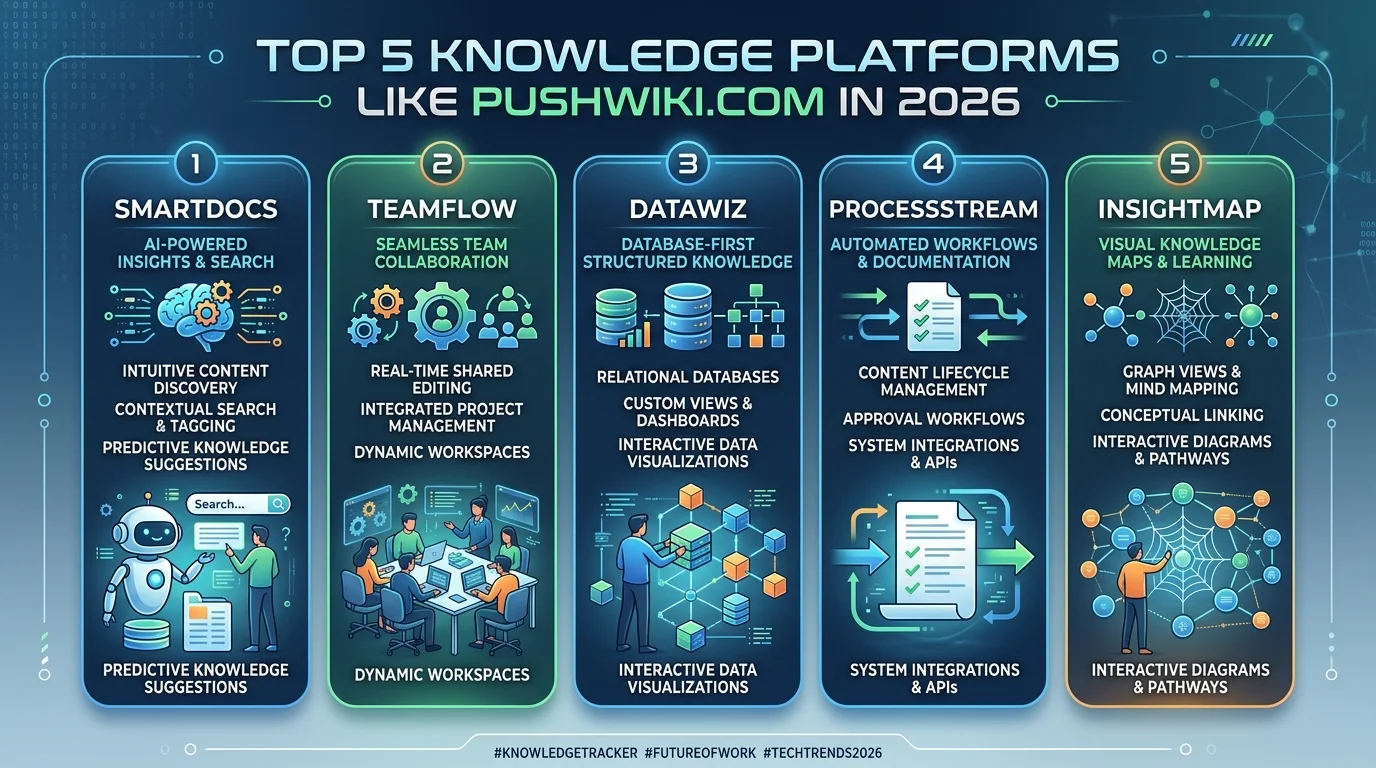
The best knowledge platforms like PushWiki.com in 2026 are Wikipedia, WikiHow, Encyclopaedia Britannica, HowStuffWorks, and Investopedia. Each one simplifies complex topics for everyday readers — the same core promise PushWiki.com makes — except these five have decades of traffic, editorial trust, and real reader loyalty behind them. Wikipedia wins for broad factual lookups, WikiHow wins for step-by-step guides, Britannica wins for expert-verified depth, HowStuffWorks wins for curiosity-driven explainers, and Investopedia wins for financial knowledge specifically. Below, you’ll get a full breakdown of each one, a side-by-side comparison table, and a simple framework for picking the right platform for your exact situation.
Now let me tell you how I got here.
I’ll be honest with you: when I first went looking for PushWiki.com alternatives, I expected a quick five-minute search. Instead, I fell into a rabbit hole of copy-paste “reviews” that all said the exact same thing about the site, almost word for word. Weird, right?
So I did what any obsessive researcher does. I dug deeper, cross-checked the traffic numbers, and pulled the actual founding history for five real knowledge platforms so you don’t have to.
Let’s get into it.
What Makes a Great Knowledge Platform Like PushWiki.com?
Before I hand you the list, let’s set some ground rules together. Not every “wiki-style” site deserves your time. Some are thin, Some are outdated and Some are, frankly, AI-generated fluff wearing a trench coat, and you deserve better than that. If you’re curious how PushWiki.com itself holds up on that front, we broke it down in detail in our PushWiki.com legitimacy review.
A genuinely great online knowledge base needs to check a few boxes:
- Depth — does it go beyond the surface, or just repeat what everyone else says?
- Trust — is the content fact-checked, expert-reviewed, or crowd-verified with real oversight?
- Structure — can you actually find what you need in under a minute?
- Longevity — has it survived long enough online to prove the model works?
Keep these four in mind. You’ll see exactly how each platform below stacks up against them.
Quick Comparison: PushWiki.com Alternatives at a Glance
Here’s the side-by-side view before you dive into the details.
| Platform | Founded | Content Model | Content Volume | Est. Monthly Traffic | Best For |
|---|---|---|---|---|---|
| Wikipedia | 2001 | Crowd-edited wiki | 7.1M+ articles | ~4.25 billion visits | Fast factual lookups |
| WikiHow | 2005 | Crowd-edited wiki | 230,000+ articles | 13M–150M+ (estimates vary) | Step-by-step guides |
| Encyclopaedia Britannica | 1768 | Expert editorial | Digital-only since 2012 | Subscription + free tiers | Verified, cite-worthy depth |
| HowStuffWorks | 1998 | Staff editorial | 40,000+ articles | ~12 million visitors | Curiosity-driven explainers |
| Investopedia | 1999 | Staff editorial | 36,000+ articles, 14,000+ terms | ~44 million visitors | Financial knowledge |
The 5 Best PushWiki.com Alternatives in 2026
Here’s where things get fun. I’ve ranked these based on real usage data, not vibes.
1. Wikipedia — The Original Knowledge Platform
Let’s start with the obvious one. Wikipedia is, quite simply, the internet’s encyclopedia. It’s a crowdsourced encyclopedia with more than 7.1 million English-language articles, and it somehow still adds around 500 new ones every single day, according to Wikipedia’s own statistics page.
Honestly? The scale is kind of hard to wrap your head around. Wikipedia’s pages have racked up 1.9 trillion views over the last decade, per Pew Research Center’s 25th-anniversary data breakdown. That’s trillion, with a T. If you want to see exactly how PushWiki.com stacks up against the real thing, we lined them up side by side in our PushWiki vs Wikipedia quick comparison.
Pros
Completely free and covers nearly every topic imaginable
Citations are visible so you can verify claims yourself
Updated constantly, often within minutes of breaking news
Cons
Anyone can technically edit it, even with oversight in place
Article quality varies a lot between popular and obscure topics
Best for: quick facts, broad topic research, and citation-backed rabbit holes.
2. WikiHow — Best for Step-by-Step How-To Guides
You know that feeling when you need to fix something right now and you don’t have time for a 20-minute YouTube tutorial? That’s WikiHow’s entire reason for existing.
Founded back in 2005, WikiHow has grown into a structured learning platform with over 230,000 how-to articles, according to Grokipedia’s profile on the site. Every guide is broken into numbered steps, often with illustrations, so you’re never left guessing what comes next.
Pros
Genuinely beginner-friendly, numbered instructions
Illustrations make abstract steps easy to visualize
Covers everyday tasks other encyclopedias skip entirely
Cons
Traffic and quality estimates vary wildly by source
Some niche or newer articles feel thin
Best for: step-by-step instructions, visual learners, and quick DIY fixes.
3. Encyclopaedia Britannica — Best for Expert-Verified Depth
Now, if you want something with a little more gravitas, Britannica is your answer. This thing has been around since 1768, according to its own corporate history. Let that sink in for a second — that’s older than the United States.
Unlike crowd-edited wikis, Britannica runs on an editorial knowledge hub model. Actual subject-matter experts write the entries, and in-house editors fact-check every single one. That’s a completely different trust signal than “anyone with an internet connection can edit this.”
Interestingly, Britannica made headlines again in March 2026 when it and Merriam-Webster sued OpenAI, alleging the company copied nearly 100,000 of their articles without permission to train its AI models. Whatever your take on that lawsuit, it says something powerful: this content is valuable enough to fight for in federal court.
Pros
Expert-written and professionally fact-checked
Trusted in academic and professional citations
Long, unbroken editorial track record since 1768
Cons
Some in-depth content sits behind a subscription
Slower to publish than crowd-edited alternatives
Best for: academic research, verified facts, and content you can actually cite with confidence.
4. HowStuffWorks — Best for Curious Minds
Here’s a fun one. Back in 1998, an engineering professor named Marshall Brain started HowStuffWorks as a side project — just a hobby, nothing fancy.
Fast forward to today, and it’s grown into a full-blown explainer website with over 40,000 articles and more than 12 million monthly visitors reaching almost 250 countries. The whole premise is beautifully simple: take something complicated — engines, black holes, blockchain, whatever — and explain it like you’re talking to a smart friend, not a textbook.
Pros
Explains genuinely complex topics in plain English
Huge topic range, from science to pop culture
Long-running brand with a real editorial history
Cons
Ad-heavy layout on some pages
Less focused than a niche specialist site
Best for: satisfying your curiosity about literally anything, from how vaccines work to how Wi-Fi actually travels through walls.
5. Investopedia — Best Niche Knowledge Platform for Finance
Last but definitely not least: Investopedia. This one’s a little different because it’s niche. Founded in 1999 by Cory Wagner and Cory Janssen, it focused entirely on making finance and investing less intimidating.
And it worked. Today, Investopedia has more than 36,000 articles and a financial encyclopedia of over 14,000 terms, pulling in tens of millions of visitors every month.
Pros
Deep glossary of financial and investing terms
Genuinely beginner-friendly explanations of complex products
Backed by a large editorial and fact-checking team
Cons
Heavily monetized with ads and affiliate content
Not a substitute for licensed financial advice
Best for: understanding investing terms, personal finance concepts, and market jargon without the headache.
How to Choose the Right Knowledge Platform for You
Okay, so you’ve got five solid options. Which one should you actually use? Let’s break it down step by step.
Step 1: Identify your intent. Are you looking for a quick fact, a how-to, or deep expertise? This alone eliminates two or three options immediately.
Step 2: Match the platform to the task. Need a definition? Go Wikipedia. Need to do something? Go WikiHow. Need airtight accuracy? Go Britannica.
Step 3: Cross-check anything important. Never rely on a single source for decisions that matter — financial, medical, or legal. Use two platforms if you have to.
Step 4: Bookmark your go-to combo. Most people end up using two or three of these regularly. That’s smart.
Frequently Asked Questions
Is Wikipedia a reliable alternative to PushWiki.com?
Yes, Wikipedia is generally more reliable than lesser-known knowledge platforms because its articles include visible citations you can verify yourself. It’s crowd-edited, so quality varies by topic, but its scale and transparency make it the strongest general-purpose option available today.
What is the best free knowledge platform in 2026?
Wikipedia remains the best free, general-purpose knowledge platform in 2026 thanks to its massive article count and visible sourcing. For step-by-step tasks specifically, WikiHow is the stronger free option.
How is Encyclopaedia Britannica different from Wikipedia?
Britannica uses paid subject-matter experts and in-house editors to write and fact-check every entry, while Wikipedia relies on volunteer contributors with community oversight. Britannica trades speed for a more controlled, professionally verified process.
Can I trust Investopedia for financial advice?
Investopedia is a strong educational resource for learning financial terms and concepts, but it is not personalized financial advice. Treat it as a knowledge platform for learning vocabulary and mechanics, then consult a licensed advisor for decisions specific to you.
Final Verdict
Look, I get it — PushWiki.com might work fine as a quick, casual starting point. But if you actually want a knowledge platform you can trust long-term, the five above — Wikipedia, WikiHow, Encyclopaedia Britannica, HowStuffWorks, and Investopedia — have earned their reputation the hard way: through years of accuracy, scale, and real reader trust.
So go ahead, bookmark one, try it out today, and see the difference for yourself.