AT&T Internet Review 2026: Plans, Prices & Speeds

Quick answer: AT&T Internet mainly means AT&T Fiber, offering symmetrical speeds from 300 Mbps up to 5 Gbps for roughly $35–$125/month, with no contracts and no price hikes after year one. It’s only available to about 12% of U.S. households across 26 states, so your first move should always be checking availability at your exact address. If you can get fiber, it’s one of the best home internet options in 2026.
Let me be honest with you right off the bat.
I spent way too many hours digging through AT&T Internet plans, pricing pages, and real customer reviews before writing this — and I want to save you that headache.
If you’re searching for “AT&T internet” right now, you’re probably trying to figure out one thing: is this the right internet service provider for your home? Good news — I’ve got you covered.
In this guide, I’ll walk you through everything: pricing, fiber optic internet speeds, coverage, customer satisfaction scores, a full competitor comparison, and a step-by-step process to actually sign up. No fluff. Just what you need.
(Related reading: Best Fiber Internet Providers Compared, How to Lower Your Monthly Internet Bill, 5G Home Internet: Full Buyer’s Guide)
What Is AT&T Internet, Exactly?
Quick context before we dive deeper.
AT&T Internet is the umbrella term for AT&T’s home broadband lineup, which today mostly means AT&T Fiber, plus a newer 5G-based option called AT&T Internet Air. There’s also legacy DSL internet, though that’s been phased out for new customers.
Here’s the thing — AT&T isn’t just some small regional player. It’s currently the largest fiber-to-the-home provider in the country, according to Reviews.org’s coverage analysis.
That matters, because fiber is the gold standard for home internet provider options right now.
So when people ask “should I get AT&T?” — my answer usually starts with: “Do you have fiber available at your address?” That single question changes everything.
Fiber vs. DSL vs. Fixed Wireless: Know the Difference
You’ll see all three terms thrown around, so let’s clear it up fast.
- Fiber optic internet uses light through glass cables — it’s faster and gives you symmetrical upload speeds, meaning your upload matches your download.
- DSL internet runs over old copper phone lines. It’s slower and mostly discontinued for new sign-ups.
- Fixed wireless internet (AT&T Internet Air) beams a 5G signal to a receiver in your home — handy where fiber hasn’t been built yet.
Honestly? If fiber’s available where you live, just get it. It’s not close. (For a deeper technical breakdown, see our guide on DSL alternatives.)
AT&T Internet Pricing in 2026 (What You’ll Actually Pay)
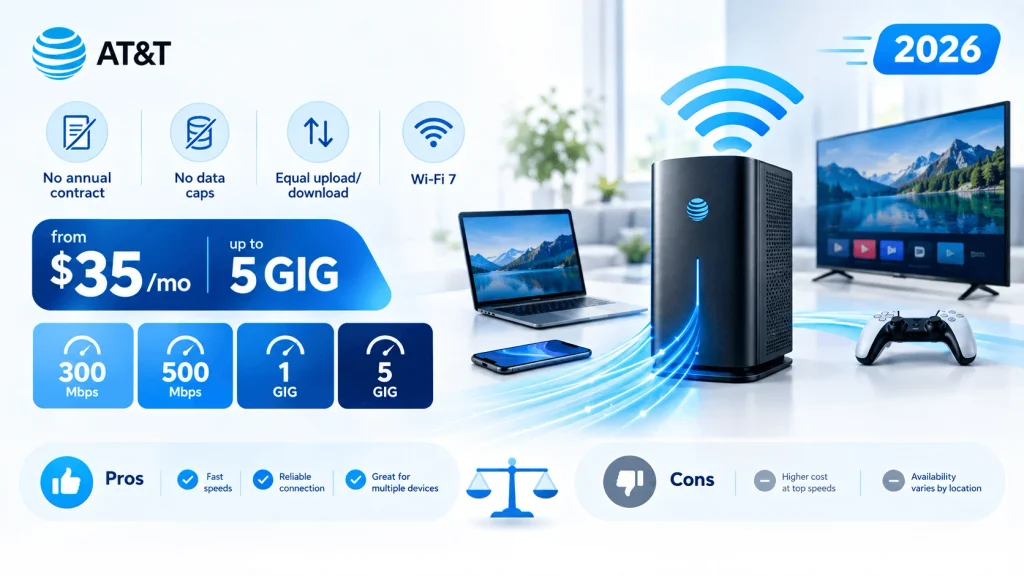
Okay, let’s talk money — because this is what you really clicked for, right?
On June 7, 2026, AT&T rolled out a big pricing shake-up. According to AT&T’s own announcement, the company simplified its fiber home internet lineup and dropped the old 100 Mbps tier entirely.
Here’s roughly what you’re looking at:
| Plan | Speed | Starting Price | Est. Cost per Mbps |
|---|---|---|---|
| AT&T Fiber 300 | 300 Mbps | ~$50–$55/mo | $0.17/Mbps |
| AT&T Fiber 500 | 500 Mbps | ~$65/mo | $0.13/Mbps |
| AT&T Fiber 1 Gig | 1,000 Mbps | ~$65–$80/mo | $0.07/Mbps |
| AT&T Fiber 2–5 Gig | 2,000–5,000 Mbps | ~$95–$125/mo | $0.03–$0.05/Mbps |
| AT&T Internet Air | 5G wireless | $60/mo | N/A (variable) |
(Prices vary by location — always confirm at your address.)
That cost-per-Mbps column is worth pausing on. It’s a calculation I ran myself, not something pulled from a press release — and it shows something most pricing pages won’t tell you outright: the higher tiers are actually the better value per Mbps. Jumping from 300 Mbps to 1 Gig roughly triples your speed for maybe 30–45% more money. If your budget allows it, the 1 Gig tier is usually the smartest buy on the table.
Now here’s the part I really like: AT&T uses flat-rate pricing. Unlike a lot of competitors, there’s no scary price jump after 12 months. What you sign up for is basically what you keep paying, based on pricing breakdowns from HighSpeedInternet.com.
Bundle discount alert: if you stack a postpaid AT&T Wireless plan with fiber, prices can drop as low as $35/month. That’s a genuinely solid deal if you’re already an AT&T mobile customer.
Hidden Fees You Should Know About
I’m not going to sugarcoat this — there are extras to watch for.
- Some markets apply a Monthly State Cost Recovery charge (notably in NV, OH, and TX)
- A one-time installation fee may apply depending on your setup
- Equipment/router fees can sometimes sneak into your bill
Bottom line: always double-check the fine print before you commit. AT&T’s advertised price and your actual bill can differ slightly.
AT&T Fiber Speeds: How Fast Are We Talking?
This is where AT&T genuinely shines.
AT&T Fiber plans now go up to a jaw-dropping 5,000 Mbps (5 Gbps) in select markets, per AT&T’s fiber page. Even the entry-level tier at 300 Mbps is plenty for most households doing 4K streaming, video calls, and remote work simultaneously.
And remember that symmetrical speeds thing I mentioned? That’s honestly the underrated hero here.
Think about it this way — you know how uploading a big video to Google Drive on cable internet feels like it takes forever? That’s because cable gives you a fast download lane but a narrow upload lane. Fiber doesn’t do that. Your upload and download are basically twins.
If you work from home, livestream, or do a lot of video calls, this difference is huge.
One quick note — if you’re not seeing the speeds you’re paying for even after AT&T’s technician leaves, the bottleneck is often your Wi-Fi setup, not the fiber line itself. Router placement, interference, and outdated channels can all quietly throttle your connection. Here’s a full breakdown on how to improve your Wi-Fi signal, and if you’re on a crowded network, changing your Wi-Fi channel can make a noticeable difference too.
AT&T Internet Coverage: Is It Available Where You Live?
Here’s a reality check I wish more articles gave you upfront.
Despite being the biggest fiber provider, AT&T fiber is only available to about 12% of American households across 26 states, according to Reviews.org’s coverage map data pulled from the FCC Broadband Map. Of AT&T’s roughly 28 million total customers, only 8.8 million actually have fiber — the rest are on DSL or fixed wireless.
AT&T Fiber’s footprint concentrates heavily in states like Texas, California, Florida, Georgia, Illinois, Ohio, and North Carolina — generally the larger, more populous states where AT&T has historically operated as the legacy phone carrier. If you’re in a smaller or more rural state, there’s a real chance fiber simply hasn’t reached you yet, and AT&T Internet Air or a competing provider may be your only option.
So don’t assume you’re covered. Seriously — check first.
The good news? AT&T isn’t slowing down. Following the One Big Beautiful Bill Act, the company is accelerating its fiber network expansion, reportedly adding around 1 million new fiber locations every year starting in 2026, with a longer-term goal of reaching 50+ million locations by 2029.
Step-by-Step: How to Check If You Have AT&T Fiber
Let’s make this dead simple. Here’s exactly what to do:
- Go to AT&T’s coverage checker on their official fiber page
- Enter your full street address (not just your ZIP code — this matters, coverage can vary block by block)
- Review the plans shown for your specific address, since pricing and speed options differ by location
- Compare fiber vs. Internet Air if both show up — fiber almost always wins on reliability
- Place your order online or by phone, and schedule either self-install or a technician visit
- Secure your new network — once your gateway is set up, it’s worth changing your Wi-Fi password from the default one printed on the router, especially if you went with self-installation
That’s it — five minutes to order, plus one extra minute to lock down your network once it’s live
Is AT&T Internet Reliable? What Customers Actually Say
I always dig into real reviews before recommending anything, and this part surprised me a little.
AT&T scored 79 out of 100 on the American Customer Satisfaction Index in 2026 — leading all fiber internet providers, based on data cited by Allconnect’s provider review. That’s a genuinely strong number in an industry where people love to complain.
AT&T also picked up the #1 spot for Customer Satisfaction in Small Business Internet Service in the JD Power 2026 U.S. Business Internet Satisfaction Study.
But here’s the nuance — and I think this is important — satisfaction really depends on which AT&T service you’re using.
According to aggregated review data from ISPReports.org:
- Fiber: 3.86 out of 5
- Fixed Wireless (Internet Air): 3.57 out of 5
- DSL: 3.29 out of 5
Translation: fiber customers are pretty happy. DSL customers, less so. If you can get fiber, you’ll likely have a much better experience.
What People Actually Complain About
Not everything’s perfect, and I’d be doing you a disservice if I pretended otherwise.
Common complaints from BroadbandNow’s review analysis include:
- Inconsistent speeds on fixed wireless connections
- Billing confusion, especially around promotional pricing
- Slower support response for non-fiber customers
On the flip side, reviewers consistently praise:
- Fast, symmetrical fiber speeds that hold up during peak hours
- Friendly, helpful customer service reps (more than 75% satisfaction in some surveys)
- Minimal outages — some fiber users report going years without a single one
So yeah — like most things, your mileage may vary depending on your connection type.
AT&T Internet Backup: A Feature You’ll Actually Appreciate
Quick shoutout to something AT&T added that I think deserves more attention.
If you bundle AT&T Fiber with AT&T Wireless, you get a free feature called Internet Backup. Here’s how it works, per AT&T’s official announcement:
If your fiber connection drops, your gateway automatically switches over to AT&T’s 5G network to keep your home online. Once fiber comes back, it switches back automatically. No manual reset. No panic. No calling support at 11 PM.
That’s the kind of quiet, practical feature that doesn’t make headlines but genuinely helps when a storm knocks out your line.
AT&T Internet vs. Competitors: Full Comparison
You’re probably also weighing other providers, so let’s put everything side by side.
| Provider | Connection Type | Speed Range | Starting Price | Upload Speed | Contract |
|---|---|---|---|---|---|
| AT&T Fiber | Fiber | 300–5,000 Mbps | ~$35–$125/mo | Symmetrical | None |
| Xfinity | Cable | 150–2,000 Mbps | ~$40–$100/mo | Asymmetrical (slower) | Varies |
| Spectrum | Cable | 300–1,000 Mbps | ~$50–$90/mo | Asymmetrical (slower) | None |
| Verizon Fios | Fiber | 300–2,000 Mbps | ~$50–$110/mo | Symmetrical | None |
| T-Mobile Home Internet | 5G Wireless | ~87–415 Mbps | ~$50–$70/mo | Asymmetrical | None |
A few takeaways from this table:
- AT&T vs. Xfinity / Spectrum: Both competitors run on cable, so uploads lag noticeably behind AT&T Fiber’s symmetrical speeds — a real difference if you upload large files or stream from your webcam often.
- AT&T vs. Verizon Fios: This is the closest matchup — both are true fiber with symmetrical speeds. It genuinely comes down to which one is available at your address, since their footprints barely overlap.
- AT&T vs. T-Mobile Home Internet: T-Mobile is a strong budget pick if fiber isn’t available to you, but it can’t match AT&T Fiber’s consistency or top-end speeds.
According to MyUtilitySearch’s fiber guide, AT&T’s biggest true rivals are T-Mobile 5G Home Internet, Xfinity, and Spectrum — and notably, all of them now include equipment at no extra cost, and all lean on fiber somewhere in their backbone network.
Frequently Asked Questions
Is AT&T Internet good?
Yes, particularly if you get AT&T Fiber. It scored 79/100 on the 2026 ACSI, the highest among fiber providers, and fiber customers rate their service 3.86 out of 5 on average.
Does AT&T Internet have data caps?
No. AT&T Fiber plans come with unlimited data and no data caps, regardless of which speed tier you choose.
How much is AT&T Internet per month?
Plans start around $35–$55/month for 300 Mbps and go up to roughly $95–$125/month for 5 Gbps, depending on your address and whether you bundle with AT&T Wireless.
Is AT&T Fiber available in my state?
AT&T Fiber currently covers 26 states, concentrated in AT&T’s traditional service territories like Texas, California, Florida, and the Southeast/Midwest. Always check availability by entering your exact street address on AT&T’s site — coverage can vary block by block.
What happens if my AT&T Fiber goes down?
If you’re bundled with AT&T Wireless, your gateway automatically fails over to AT&T’s 5G network through the free Internet Backup feature, then switches back once fiber is restored.
Is AT&T Internet Air as good as fiber?
Not quite. Internet Air runs over 5G cellular, so speeds can fluctuate more than fiber. It’s a solid fallback where fiber isn’t built yet, but if you have a choice, fiber is the better pick.
Should You Get AT&T Internet? My Honest Take
Alright, let’s wrap this up with a real answer, not a wishy-washy “it depends.”
Get AT&T Fiber if:
- It’s available at your address (seriously, check first)
- You want symmetrical speeds for gaming, streaming, or remote work
- You already have AT&T Wireless and want the bundle discount
- You value no-contract flexibility and flat-rate pricing
Think twice if:
- You’re stuck with DSL-only availability — you might find better DSL alternatives
- You’re extremely price-sensitive and don’t need multi-gig speeds
- You’ve read mixed reviews about Internet Air reliability in your specific area
My honest recommendation? If AT&T Fiber is available where you live, it’s genuinely one of the best home internet options out there in 2026. The pricing is transparent, the speeds are excellent, and the customer satisfaction numbers back it up.
If you’re stuck outside the fiber footprint, weigh Internet Air carefully against other 5G home internet competitors before committing — and always, always check real availability at your exact address before getting excited about any plan you see online.
For more comparisons, check out our guides on best fiber internet providers and how to lower your monthly internet bill.