Zaubee Reviews 2026: Is It Legit? Verdict + Removal Guide

Quick answer: Is Zaubee legit? Yes, in the narrow sense that Zaubee.com is a real, operating business directory, not a credit card stealing scam. But as the Zaubee reviews from business owners show, it functions more like a data broker that scrapes business information without consent, and its removal process is notoriously broken. If your business shows up there uninvited, you can get it fixed. I’ll show you exactly how below.
So you Googled your own business name and found something weird staring back at you on Zaubee.com, right?
Yeah. I’ve been there too, and that’s exactly why I sat down and spent way too many hours digging into this thing.
Let me be straight with you: “is Zaubee legit” is not a yes or no question. I wish it were. It’s messier than that, and honestly, most of the Zaubee reviews floating around give you a lazy answer because they never actually looked at the user complaints or the corporate registration records.
I did.
In this guide, I’ll walk you through exactly what Zaubee is, why business owners are furious, what the trust score tools actually say (spoiler: they disagree with each other), and, most importantly, what you should do if your business shows up there without your permission. If you’ve already found your business listed, my dedicated guide on how to remove or update a Zaubee business listing walks through the process in more depth.
Grab a coffee. This one’s long, but it’ll save you hours of scattered searching.
What Exactly Is Zaubee.com?
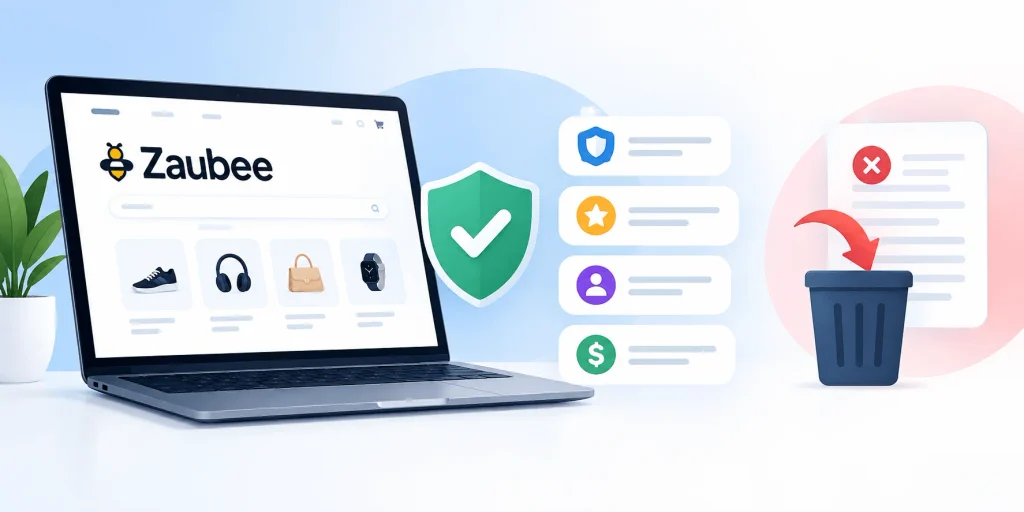
Before you panic, let’s slow down and figure out what this online business directory actually is.
Zaubee is, on paper, a global business listing platform. Think of it like a cousin to Yelp or Google Maps: you search a business name, and it pulls up an address, phone number, photos, and sometimes reviews.
Sounds harmless, right? Almost boring, even.
But here’s the twist. Zaubee isn’t run by some Silicon Valley team with a slick office. It’s operated by Zaubee Internet Private Limited, a company incorporated in October 2018 in Orissa, India, with a registered capital of less than $10,000.
That’s not automatically a red flag. Plenty of legit small companies start scrappy.
But combine that small footprint with what users are actually reporting, and things start looking a little different.
Who Runs Zaubee, and Why Does That Matter?
I know, “who owns the website” sounds like a boring detail. But trust me, it matters more than you’d think when you’re trying to figure out website legitimacy.
Zaubee is listed under two directors, and the company uses NameCheap for domain hosting and Cloudflare for its network layer, according to Scamadviser’s technical breakdown.
Neither of those facts is damning on its own. Loads of legitimate sites use Cloudflare.
The real issue isn’t who owns it. It’s what they do with your business data once it’s on the site.
Is Zaubee Legit? Here’s What the Trust Score Tools Actually Say
Okay, this is where it gets genuinely confusing, and I want to walk you through it honestly instead of pretending there’s a clean answer.
I checked four separate scam checking tools, and I got four wildly different scores. That alone should tell you something about how unreliable automated trust scores can be.
Here’s the breakdown in one place so you don’t have to hunt through four different sites:
| Trust check tool | Score | Verdict |
|---|---|---|
| Scamadviser | 76% | “Probably not a scam but legit,” medium to low risk |
| Scam Detector | 58.1 | Medium risk; flags poor metadata and design |
| ScamDoc | 95% | “Excellent” trust score |
| ScamMinder | 100/100 | Legitimate, but warns of possible fake reviews |
See the problem? You’ve got scores ranging from 58 to 100 for the exact same website.
That’s not a glitch. That’s the nature of automated trust score algorithms: they mostly look at technical stuff like SSL certificates, domain age, and hosting reputation. They don’t read the actual human complaints.
And that’s exactly where the real story is hiding.
Zaubee Reviews: The Real Controversy Is Unauthorized Business Listings
This is the part nobody talks about enough, and honestly, it’s the reason I wrote this whole article.
The technical trust scores are fine. But when you actually read the Zaubee reviews from real business owners, a very different picture appears.
Zaubee has been repeatedly flagged as functioning like a data broker, meaning it pulls (or “scrapes”) business information from other sources across the web and republishes it, often without ever asking the business owner first.
What Business Owners Are Actually Reporting
I went through dozens of reviews on Trustpilot, and honestly, the pattern is pretty consistent.
Here’s what keeps coming up:
- Business owners discover a listing they never created, complete with their name, phone number, and home address.
- Attempts to edit or remove the listing hit a wall: the contact form is broken, or requests go unanswered for over a year.
- Users are asked to submit a phone number just to request a correction, which understandably makes people nervous about where that number ends up.
- Some listings include incorrect professional titles or outdated photos, which can quietly damage a business’s reputation without the owner even knowing.
One reviewer put it bluntly, describing how they’d spent over a year trying to get their information removed with no luck.
Another flagged something genuinely concerning: their home address ended up attached to a business listing they never submitted, which isn’t just annoying. It’s a safety and privacy risk.
Why This Happens: The Data Scraping Business Model
Here’s the thing you need to understand about directory scraping.
Many business directories, not just Zaubee, build their databases by pulling public information from other sites, government records, or old listings elsewhere on the web.
It’s cheap. It’s fast. And it lets a small platform look like it has millions of listings overnight.
The problem is consent. Legitimate directories usually let you claim, verify, and control your listing. When that control is missing, or nearly impossible to access, you end up with the exact mess Zaubee users are describing.
Zaubee vs. Google Business Profile vs. Yelp
Here’s how Zaubee actually stacks up against the directories you already trust:
| Feature | Zaubee | Google Business Profile | Yelp |
|---|---|---|---|
| Requires consent to list | Often scraped without consent | Owner claims listing | Owner can claim/verify |
| Easy to edit/remove info | Broken contact form reported | Direct dashboard access | Direct dashboard access |
| Transparent ownership | Small, low capital private company | Yelp Inc. (public company) | |
| Trust score consistency | Ranges 58 to 100 across tools | Universally trusted | Universally trusted |
| Review authenticity controls | Limited moderation reported | Established moderation | Established moderation |
The gap isn’t that Zaubee has listings pulled from other sources; plenty of directories start that way. It’s that the correction and removal process is where it falls apart compared to established players. For a deeper side by side, check out my full Zaubee vs. Google comparison.
How to Remove Your Business From Zaubee (Step by Step)
Alright, let’s get practical. If you found your business (or yourself) listed on Zaubee without permission, here’s exactly what I’d do, step by step.
Step 1: Screenshot Everything First
Before you touch anything, document what’s there.
Take a full screenshot of the listing, the URL, the incorrect information, the date. You’ll want this as evidence if things escalate.
Step 2: Submit a Formal Removal Request
Go through Zaubee’s contact form and formally request removal or correction.
Yes, users report this form is often broken or slow. Try anyway, and keep a dated copy of every message you send.
Step 3: Audit Your Business Citations Elsewhere
This is the step most people skip, and it’s a mistake.
Your Zaubee listing probably didn’t come from nowhere; it was likely scraped from another business citation site. Use a tool like BrightLocal to find every place your business info is duplicated online, and see my roundup of top free business directories in the USA to know which ones are actually worth claiming.
Step 4: Consider a Data Broker Removal Service
If manual removal isn’t working (and for a lot of people, it isn’t), a service like Optery specializes in exactly this: automated and custom data broker opt outs. If your issue is more about reputation than data removal specifically, my NetReputation review covers a service built for that broader cleanup.
It’s not free, but it saves you the headache of chasing down dozens of sketchy directories one by one.
Step 5: Build Authoritative Content on Your Own Site
Here’s a trick a lot of people miss.
Publish clear, keyword rich content on your own website that specifically targets your business name and location. Google tends to prioritize your own verified site over a scraped directory listing, so this quietly pushes Zaubee further down the search results.
Step 6: Monitor Regularly
Set a calendar reminder every few months to search your business name and check nothing new has popped up.
Online reputation management isn’t a one time fix. It’s ongoing maintenance, kind of like weeding a garden.
Final Verdict: Is Zaubee Legit or Not?
Let me pull this all together into one clear answer.
Zaubee is a real, legally registered company, not an outright scam trying to steal your money. It has an SSL certificate, legitimate hosting, and it operates in the open. On that narrow, technical definition, it’s “legit.”
But legitimacy isn’t just about whether a company exists. It’s about whether it treats your data, and your business reputation, with respect.
And on that front, Zaubee falls short. It behaves like a poorly managed data broker: scraping business details without consent, offering little to no easy way to correct or remove them, and requiring a phone number for something as simple as a takedown request.
So here’s my honest bottom line: Zaubee won’t scam your wallet, but it might mishandle your business identity. Treat it the way you’d treat any data broker, check if you’re listed, and if you are, work through the removal steps above.
Frequently Asked Questions About Zaubee
Is Zaubee legit?
In the technical sense, yes. Zaubee is a registered company with a real website, an SSL certificate, and legitimate hosting. But Zaubee reviews from business owners describe listings created without consent and a removal process that rarely works, so treat it like a data broker.
What do Zaubee reviews say?
Reviewers on Trustpilot describe a consistent pattern: listings they never created, a contact form that is broken or ignored for over a year, and a phone number required just to request a correction. Some also report incorrect professional titles, outdated photos, or a home address attached to a listing they never submitted.
Is Zaubee.com a scam?
Not in the traditional sense. Zaubee is a registered company operating a real website, so it’s not stealing payments or credit card details. The bigger issue is that it functions like a data broker, publishing business listings scraped from other sources, often without the owner’s consent.
Why is my business listed on Zaubee without my permission?
Zaubee builds much of its directory by scraping public business data from other sites and sources rather than requiring businesses to sign up directly. That’s why many owners discover listings they never created.
How do I remove my business from Zaubee?
Screenshot the listing, submit a formal request through Zaubee’s contact form, and if that doesn’t work, use a data broker removal service like Optery to escalate the request. For the full walkthrough, see my guide on removing or updating a Zaubee business listing.
Is it safe to give Zaubee my phone number to remove a listing?
Proceed cautiously. Several reviewers on Trustpilot report suspicion about why a phone number is required just to request a correction. Consider using a secondary or business only number when submitting removal requests.
Is Zaubee’s trust score reliable?
Not entirely. Trust score tools disagree significantly, ranging from 58.1 to 100 across four different checkers. These scores mostly evaluate technical factors like SSL and hosting, not the actual user complaints about unauthorized listings.