
Why More Businesses Are Turning to AI Tools for Daily Operations

Artificial intelligence is becoming a regular part of how businesses operate. What once seemed like technology reserved for large corporations is now being used by small businesses, growing companies, and established organizations to manage everyday responsibilities. From handling customer inquiries to organizing financial records, AI tools are helping businesses rethink how work gets done.
The growing interest in AI is not simply about keeping up with technology trends. Many businesses are dealing with rising operating costs, increasing customer expectations, and employees who have more responsibilities than they can comfortably manage. Traditional processes often struggle to keep pace, particularly when teams depend on manual data entry, disconnected software, and repetitive administrative tasks.
According to the U.S. Chamber of Commerce’s 2025 Empowering Small Business Report, 58% of surveyed U.S. small businesses reported using AI, compared with 23% in 2023. This growth suggests that AI is becoming more accessible to organizations that previously lacked the resources to invest in advanced technology.
However, adopting AI does not automatically make a business more productive. The real difference comes from understanding which tasks benefit from automation, where human judgment remains essential, and how technology can improve existing processes without creating unnecessary complications.
The Shift From Manual Work to AI-Assisted Operations
Many businesses still rely on operational routines that have changed very little over the years. Employees collect information from different systems, manually prepare reports, answer similar customer questions, and spend considerable time coordinating everyday activities.
Although each task may appear small, the combined workload can become significant. An employee who spends 20 minutes preparing a daily report, for example, loses several hours each month completing work that could potentially be simplified.
AI tools offer a different approach by assisting employees with information processing, document preparation, scheduling, and routine communication. Instead of building every process around manual input, organizations can use technology to handle predictable activities while employees concentrate on more complicated responsibilities.
The distinction becomes clearer when comparing common operational tasks.
| Business activity | Traditional approach | AI-assisted approach |
| Customer support | Employees manually answer every inquiry | AI handles routine questions and routes complex cases |
| Data reporting | Staff collect and organize figures manually | AI assists with summaries and identifies patterns |
| Appointment scheduling | Employees coordinate availability through calls and emails | Scheduling systems suggest suitable times and manage reminders |
| Inventory management | Stock levels are checked periodically | Predictive tools help estimate demand and flag potential shortages |
| Document processing | Information is entered from documents by hand | AI extracts relevant details for employee verification |
| Internal communication | Teams prepare routine updates manually | AI drafts summaries and organizes action items |
These improvements are not necessarily dramatic when viewed individually. Their value becomes more apparent when the same activities are repeated across departments, locations, or hundreds of customer interactions.
Why Businesses Are Increasing Their Investment in AI Tools
Businesses are adopting AI for different reasons, but the decision often begins with a practical operational challenge rather than an ambitious technology strategy.
A company may struggle to respond to customers quickly enough, while another may have employees spending too much time preparing reports. AI becomes attractive when it provides a realistic way to address these problems without immediately expanding the workforce or rebuilding existing systems.
1. Reducing the Burden of Repetitive Administrative Tasks
Administrative work is necessary for almost every business, but not all administrative activities require constant human involvement.
Employees regularly handle meeting notes, data entry, appointment confirmations, document formatting, and internal reporting. These tasks support daily operations, yet they can take time away from work that requires creativity, problem-solving, or direct interaction with customers.
AI tools can help reduce this burden by supporting activities such as:
- Preparing first drafts of routine emails, reports, and internal announcements.
- Extracting relevant information from invoices, forms, and business documents.
- Summarizing meeting discussions and identifying follow-up responsibilities.
- Categorizing customer requests before assigning them to appropriate departments.
- Organizing large collections of internal documents for easier information retrieval.
- Identifying missing information or inconsistencies in operational records.
For example, an accounting department receiving hundreds of invoices each month may use document-processing software to extract supplier names, invoice numbers, and payment amounts. Employees can then review the information rather than entering every detail manually.
“A lot of time gets lost in small tasks like preparing reports, organizing campaign data, and writing routine updates. AI can help take care of that repetitive work, giving employees more time to focus on strategy and solving actual customer problems,” says David Finberg, CEO of Peaks Digital Marketing.
The process still requires appropriate verification, particularly when financial records are involved. However, reducing repetitive data entry can give staff more time to investigate discrepancies and manage complex transactions.
2. Managing Operating Costs Without Sacrificing Service Quality
Growing a business usually means handling more customers, transactions, and internal responsibilities. Traditionally, organizations have responded to increasing workloads by hiring additional employees or extending working hours.
Those approaches may be necessary, but they also introduce additional expenses related to recruitment, training, salaries, and management.
AI offers businesses another option by helping existing teams manage higher volumes of routine work.
A customer service department, for instance, may receive repeated questions about order tracking, return policies, or appointment availability. An AI-powered support system connected to accurate company information can respond to straightforward inquiries while directing unusual or sensitive cases to employees.
This arrangement can help reduce unnecessary workload without removing the human support customers need.
However, cost savings should not be assumed. Software subscriptions, integration work, employee training, and ongoing monitoring all affect whether an AI investment is financially worthwhile.
Companies therefore need to compare the total cost of implementation against measurable improvements in service quality, employee capacity, and operational efficiency.
3. Improving the Speed of Business Decisions
Business decisions frequently depend on information collected from several sources. Sales figures may be stored in one system, customer feedback in another, and inventory records in a separate application.
When employees must manually combine these records, important information can arrive too late to influence decisions.
AI-powered analytics tools can assist by processing large datasets, identifying patterns, and highlighting information that deserves management attention.
For example, a retail business could use predictive analytics to examine purchasing trends, seasonal demand, and stock movement. This may help managers identify products that require replenishment or items that are unlikely to sell at their current rate.
Similarly, a service-based company could analyze customer complaints to identify recurring delivery problems.
These insights can support better decisions, but they should not be treated as unquestionable conclusions. Poor-quality data, incomplete records, and unexpected market conditions can produce misleading recommendations.
Businesses still need experienced employees who understand the circumstances behind the numbers.
Where AI Tools Are Making the Biggest Operational Difference
AI adoption is not limited to technology companies or departments with specialized technical knowledge. Organizations across different industries are exploring practical applications that fit their existing responsibilities.
McKinsey’s August 2026 global AI survey found that nearly nine in ten respondents reported regular AI use in at least one business function. The same research found that 44% reported scaling AI across their enterprises, showing that widespread experimentation does not necessarily translate into organization-wide implementation.
The following examples illustrate how AI can support different departments.
| Department | Practical AI applications | Potential business benefit |
| Human resources | Resume organization, employee onboarding assistance, training support | Less routine administrative work |
| Finance | Invoice processing, expense categorization, anomaly detection | Faster financial administration |
| Marketing | Campaign analysis, content drafting, customer segmentation | More efficient campaign planning |
| Sales | Lead organization, CRM summaries, follow-up drafting | Better visibility into sales opportunities |
| Customer service | Chatbots, ticket classification, response suggestions | Faster handling of common inquiries |
| Operations | Demand forecasting, scheduling assistance, workflow monitoring | Improved coordination and resource planning |
The most useful application depends on the organization’s actual problems. A business struggling with customer response times may benefit more from support automation than predictive inventory software, regardless of which technology receives more attention.
How AI Tools Are Changing Customer Expectations
Customer expectations have gradually shifted toward faster communication, convenient digital services, and more personalized experiences.
People increasingly expect businesses to provide information outside traditional working hours. They also want employees to understand previous interactions without requiring them to explain the same issue repeatedly.
AI-powered customer service systems can help organizations respond to these expectations when they are properly connected to relevant business information.
For example, an online retailer may use an AI assistant to help customers locate products, understand delivery policies, and check the status of existing orders. When a customer encounters a complicated refund dispute, the system can transfer the conversation to a human representative.
“Customers expect businesses to respond quickly, but they also want accurate answers and personal attention. AI can help teams manage common questions and organize customer information, while employees focus on conversations that need a more personal approach,” says Ethan Richardson, CMO of Exquisite Timepieces Inc.
The goal should be to make support easier to access rather than create another barrier between customers and employees.
Businesses introducing AI-based customer communication should prioritize several practices:
- Make it clear when customers are interacting with an automated assistant.
- Provide an accessible way to reach a human representative.
- Connect automated responses to current and accurate company policies.
- Avoid collecting unnecessary personal information during conversations.
- Review unresolved inquiries to identify weaknesses in automated responses.
Businesses should also examine whether customers are receiving useful answers rather than measuring success only through the number of inquiries handled automatically.
A chatbot that closes conversations quickly but leaves customers confused may create additional work for the support team.
The Growing Importance of AI in Small Business Operations
Small businesses often experience operational pressures differently from large corporations. A small team may be responsible for sales, customer service, marketing, accounting, and supplier relationships simultaneously.
When employees perform several roles, even modest improvements in administrative efficiency can make a meaningful difference.
Consider a small property management company that handles tenant inquiries, maintenance requests, contractor scheduling, and rental documentation.
Rather than introducing a complicated automation system across the entire business, management could begin by using AI to organize incoming maintenance requests and draft routine tenant communications.
This would allow employees to spend more time coordinating actual repairs and resolving complicated tenant concerns.
A similar approach could benefit a local marketing agency. AI tools could help prepare meeting summaries, organize campaign data, and develop initial content outlines while employees remain responsible for creative direction, client relationships, and final deliverables.
The advantage is not necessarily that small businesses can operate with fewer employees. AI can help existing teams manage their responsibilities more consistently as demand increases.
Research from the U.S. Chamber of Commerce also suggests that smaller organizations are finding immediate value in relatively straightforward applications such as scheduling, reporting, and administrative work, while adoption barriers still include training, costs, and uncertainty about returns.
Why Businesses Are Moving Beyond Individual AI Tools
The first stage of AI adoption often involves employees experimenting independently. One person uses an AI writing assistant, another summarizes meeting notes, and someone else uses AI to analyze a spreadsheet.
These applications may improve individual productivity, but they do not always solve larger organizational problems.
For example, a sales employee might prepare a customer proposal faster using AI. However, if the proposal still requires several manual approvals, information from disconnected systems, and repeated revisions, the overall process may remain slow.
Businesses are therefore beginning to examine how AI can support complete workflows rather than isolated tasks.
From Individual Assistance to Connected Workflows
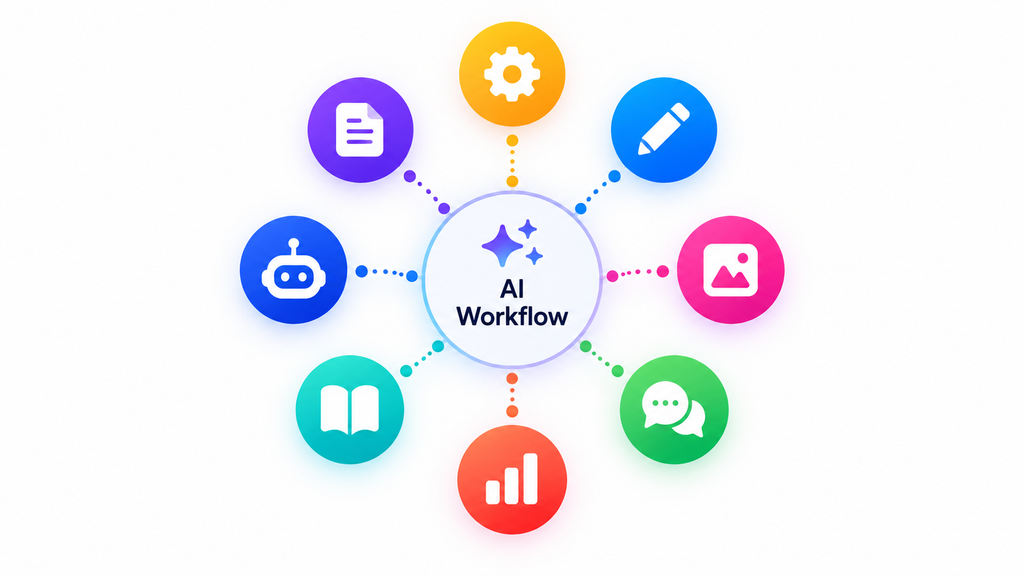
A connected AI-assisted workflow might involve:
- Receiving a customer request through an approved communication channel.
- Identifying the type of inquiry and retrieving relevant business information.
- Preparing a suitable response or assigning the issue to an employee.
- Recording the interaction in the customer management system.
- Flagging unresolved problems for follow-up.
Such a system may involve AI alongside conventional software automation. The distinction matters because not every step needs a language model or an advanced AI agent.
Simple rules may be more reliable for predictable activities, while AI can assist when information is unstructured or requires interpretation.
For businesses, choosing the simplest reliable solution is often more valuable than introducing unnecessary complexity.
The Hidden Costs Businesses Should Consider Before Adopting AI
Although AI tools can improve efficiency, the purchase price is only one part of the investment.
Organizations may need to modify existing processes, connect different software platforms, train employees, and introduce additional safeguards to manage sensitive information.
A tool that initially appears affordable can become expensive when multiple departments require subscriptions or when technical integration demands specialist support.
Common AI implementation costs and their implications
| Cost category | What businesses should consider |
| Software subscriptions | Monthly fees, usage limits, additional seats, and premium features |
| Integration | Connecting AI systems with existing business software |
| Training | Helping employees understand appropriate uses and limitations |
| Data preparation | Cleaning, organizing, and securing business information |
| Quality control | Reviewing outputs, correcting errors, and measuring accuracy |
| Maintenance | Updating workflows as business requirements change |
Businesses should also account for the possibility that AI-generated mistakes create additional work.
An incorrect financial summary, inaccurate customer response, or poorly classified service request can offset the time saved through automation.
A sensible investment decision therefore considers both the benefits and the resources needed to achieve them.
Why Employee Training Matters as Much as the Technology
One common mistake is assuming that employees will automatically understand how to use AI tools once they receive access.
In practice, employees may use the same system in very different ways. Some may rely too heavily on generated information, while others may avoid the technology because they do not understand its capabilities.
Effective training should explain how AI fits into specific job responsibilities.
A marketing employee, for example, may need guidance on verifying research, checking brand accuracy, and reviewing AI-generated content. Someone working in finance requires different instructions concerning confidential information, numerical accuracy, and financial controls.
A practical employee training program should cover:
- Which tasks are approved for AI assistance and which require manual handling.
- How to recognize inaccurate, incomplete, or misleading outputs.
- What company information employees are permitted to enter into AI systems.
- When to request approval or involve a supervisor.
- How to report errors, security concerns, or unexpected system behavior.
Training should also involve employees in identifying useful applications. Staff members who perform daily tasks often understand operational problems better than outside technology vendors.
“Introducing new technology is only useful when employees know how it fits into their daily responsibilities. Clear training and communication help teams use these tools confidently without losing the human judgment that important decisions require,” says Sharon Amos, Director of Air Ambulance 1.
Their feedback can prevent businesses from purchasing tools that look impressive during demonstrations but create frustration in normal working conditions.
The Risks of Relying Too Heavily on AI for Daily Operations
As AI becomes integrated into everyday business activities, organizations must pay closer attention to accountability, privacy, and operational reliability.
One concern involves inaccurate information. Generative AI systems can produce confident responses that contain factual errors or unsupported conclusions. When these responses are incorporated into business processes without review, the consequences may affect customers, finances, or professional relationships.
Data protection is another consideration. Employees may unknowingly expose confidential company documents or customer information by entering them into tools that have not been approved for business use.
The National Institute of Standards and Technology’s Generative AI Profile emphasizes the importance of governance, documentation, oversight, and risk management when organizations deploy generative AI systems.
Businesses can reduce avoidable risks by introducing clear operating procedures and assigning responsibility for AI-assisted decisions.
Not every activity requires the same level of oversight. Drafting an internal meeting agenda involves fewer potential consequences than approving a financial transaction or providing information that could influence someone’s health.
Organizations should therefore match the level of human review to the importance and potential consequences of each task.
How Businesses Can Measure Whether AI Is Actually Working
Adopting AI because competitors are using it does not provide a meaningful measure of success.
A business needs to understand whether the technology improves outcomes that matter to its customers, employees, and overall operations.
Before implementing a tool, management should establish a baseline using existing performance data. After introduction, the same indicators can be measured to determine whether improvements are consistent and worthwhile.
| Performance indicator | What it helps measure |
| Average task completion time | Whether employees complete routine work faster |
| Customer response time | Whether inquiries receive more timely attention |
| Error and correction rates | Whether automation maintains acceptable accuracy |
| Cost per transaction | Whether operational expenses are improving |
| Employee satisfaction | Whether tools make work easier or introduce frustration |
| Customer satisfaction | Whether service quality improves after implementation |
For example, a business introducing AI-assisted customer support might compare response times before and after deployment. However, it should also measure how often customers need additional assistance and whether complaints increase.
“As businesses start using AI for more daily tasks, they also need to think about the infrastructure running those tools. Having reliable hosting and enough computing resources becomes important when companies automate workflows, process large amounts of data, or run AI-powered applications,” says Tal Holtzer of VPSServer.
Similarly, faster document processing should be evaluated alongside the number of corrections employees must make.
Measuring multiple outcomes helps businesses avoid mistaking increased activity for genuine improvement.
A Practical Approach to Introducing AI Into Business Operations
Companies do not need to automate every department simultaneously. In fact, implementing too many tools at once can make it difficult to identify which investments are producing results.
A more manageable strategy begins with one clearly defined operational problem.
Step 1: Identify the Most Time-Consuming Processes
Managers should examine tasks that employees repeat frequently, particularly those involving information retrieval, document preparation, or routine communication.
The goal is to identify activities where AI assistance can provide measurable value without introducing unnecessary risk.
Step 2: Evaluate Existing Software
Many business platforms already include AI-supported features. Before purchasing separate applications, organizations should review whether their current accounting, customer management, or collaboration systems offer suitable capabilities.
Using existing software may reduce integration requirements and simplify employee training.
Step 3: Run a Limited Pilot
A pilot project allows businesses to test AI in a controlled environment before making broader commitments.
For example, a company might introduce AI-assisted document processing for one type of invoice while maintaining its existing approval procedures.
Employees can then compare processing times, accuracy, and overall workload.
Step 4: Review Results and Employee Feedback
Management should assess whether the pilot genuinely improved operations and whether employees encountered unexpected difficulties.
If the results are promising, the company can gradually expand the system to similar tasks while preserving appropriate safeguards.
Step 5: Establish Long-Term Oversight
AI adoption should not end after implementation. Businesses need to review system performance, update access permissions, maintain documentation, and reassess whether the technology continues to meet operational needs.
This ongoing evaluation is especially important when customer requirements, regulations, or internal processes change.
The Future of AI in Everyday Business Operations
AI tools are likely to become more closely integrated with the software employees already use. Rather than opening separate applications for every activity, businesses may increasingly access AI assistance directly through accounting platforms, customer relationship management systems, scheduling tools, and workplace collaboration software.
Another important development involves AI agents that can coordinate several steps within a defined workflow. These systems may help retrieve information, prepare documents, update records, and request approvals while operating within established permissions.
However, the shift toward more capable systems also raises questions about reliability and accountability. Greater automation does not eliminate the need for clear business policies, reliable data, and employees who can intervene when something goes wrong.
The most successful organizations are unlikely to be those that automate the greatest number of tasks. They will be those that understand where automation improves performance, where employees provide essential judgment, and how both can work together effectively.
Conclusion
Businesses are turning to AI tools because everyday operations are becoming more demanding. Employees are expected to handle larger workloads, customers want faster assistance, and management teams need accurate information to make timely decisions.
AI can help address these challenges by reducing repetitive tasks, supporting customer service, improving information processing, and making operational data easier to use. Its benefits, however, depend on thoughtful implementation rather than simply purchasing the latest technology.
Organizations that begin with practical problems, involve employees, measure outcomes, and maintain appropriate human oversight are better positioned to achieve lasting improvements.
Ultimately, the value of AI in daily business operations comes from helping people work more effectively. When businesses focus on that objective, technology becomes a useful part of their operations rather than another system employees must struggle to manage.