Real-Write AI Review: Does It Work? | Honest Test

Real-Write is an AI text humanizer that rewrites AI-generated content to sound more natural by varying sentence rhythm and tone. It’s genuinely useful for editing AI-assisted drafts and improving readability — but it is not a guaranteed way to evade AI detectors, and using it to disguise AI work in academic or professional settings carries real risk. Here’s everything you need to know before you use one.
Let’s be real for a second.
You’ve probably typed a query into ChatGPT, gotten a decent draft back, and then thought… hmm, this sounds a little stiff.
That’s normal. AI-generated text has a “voice” — overly formal, weirdly repetitive, allergic to contractions. That’s the gap tools like Real-Write are trying to fill.
I dug into how Real-Write and its competitors actually work, what they claim, and — more importantly — where the real risks are. So in this article, I’ll walk you through it all: what the tool does, how AI humanizers work under the hood, when they’re genuinely useful, and where you need to slow down and think twice.
No fluff. Just what you need to know.
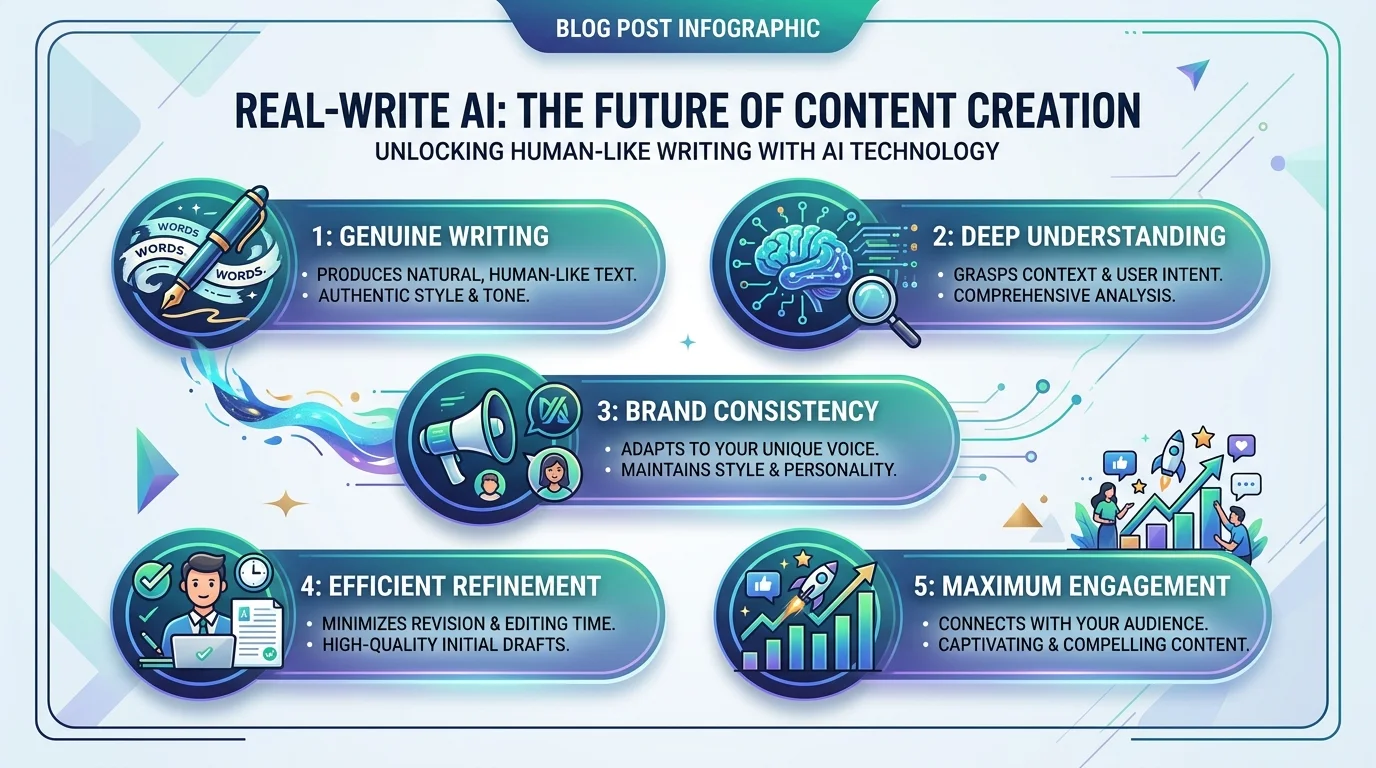
What Is Real-Write, Exactly?
Real-Write sits in a growing category called AI text humanizers. You paste in text written (or heavily assisted) by a model like ChatGPT or Claude, and the tool rewrites it to sound more natural — varying sentence length, swapping in contractions, loosening tone, breaking up repetitive patterns.
If you want a broader look at this category before going deeper, I’d also recommend checking out this roundup of top AI humanizer tools for human-like writing — it’s a solid companion read alongside this review.
What the tool claims
According to its product page, Real-Write says it was trained on a large library of academic papers, essays, and AI-generated text, and it supports rewriting in more than 100 languages.
How it compares to other humanizers
You’ll find dozens of tools competing here — Grammarly’s AI Humanizer, WriteHuman, QuillBot, and Phrasly AI among the most visible. Here’s how they stack up on the essentials:
| Tool | Free Tier | Languages | Detector Bypass Claims* | Best For |
|---|---|---|---|---|
| Real-Write | Yes | 100+ | Not independently verified | Students, researchers, general editing |
| WriteHuman | Limited | 40+ | Reported strong vs. Pangram Labs, Quetext | Long-form content, blog posts |
| QuillBot | Yes | Multiple | Reported ~71% in third-party testing | Grammar + light paraphrasing |
| Phrasly AI | Limited | Multiple | Positioned as output-quality leader | Blog-length content |
| Grammarly | Yes | 6 major languages | Focused on transparency, not bypass | Authorship disclosure, editing |
*Bypass figures come from third-party testing roundups published by competing vendors, not independent academic studies — treat them as directional, not definitive.
The takeaway: no tool in this category has independently audited bypass rates. Every number you see online comes from the vendor itself or a competitor’s marketing blog.
How Do These Tools Actually Work?
Here’s the part most marketing pages gloss over.
AI detectors — like GPTZero, Turnitin, and Originality.ai — don’t “read” your text for meaning. They analyze statistical patterns. If you want to understand this from the detector’s side of the fence, I broke it down in more depth in my GPTZero review.
Perplexity
Perplexity measures how predictable your word choices are. AI models tend to pick the most statistically likely next word, repeatedly. That’s low perplexity, and it’s a red flag to detectors.
Burstiness
Burstiness measures how much your sentence length and rhythm varies. Humans naturally write a short sentence, then a long rambling one, then something clipped. AI tends toward a much more uniform rhythm.
Humanizer tools try to nudge both numbers — increasing variation, injecting natural phrasing, disrupting the too-perfect patterns detectors are trained on. That’s the mechanism. It’s clever engineering. It’s not magic, and it’s not foolproof.
The Honest Risk You Need to Understand First
I’m not going to sugarcoat this one.
A huge chunk of the marketing around tools like Real-Write leans hard into phrases like “bypass Turnitin” and “beat GPTZero.” If you’re a student, or you work somewhere with an AI-use policy, that’s not a small detail — it’s the whole ballgame.
Detection accuracy is inconsistent
Independent testing roundups show that even strong humanizer output gets flagged by some detectors while sliding past others — there’s no universal “safe” score across the industry. A tool that beats GPTZero might still get flagged by Turnitin or Originality.ai on the same piece of text.
Institutions are catching up
Universities and employers increasingly treat any sign of AI-assisted rewriting-to-evade-detection as a policy violation — regardless of whether a detector actually flags it. The intent matters, not just the score.
So ask yourself: is the goal to improve your writing, or to hide where it came from? Those are different use cases, and only one is worth the risk.
Where Real-Write (and Tools Like It) Genuinely Help
You’re not always trying to fool anyone. Sometimes you just want your content to read better. Here’s where I’d actually recommend it:
- Cleaning up your own AI-assisted first drafts — you used AI to get past the blank page, but it reads like a textbook. A humanizer pass, followed by your own edit, knocks off the robotic edge fast.
- Non-native English writing — smooths phrasing so your ideas land the way you intend, without losing your meaning.
- Marketing and blog copy — loosens tone for content marketing, email copy, and social captions, provided you review for accuracy and brand voice after.
- Speed-editing long-form content — if you’re publishing at volume, using a humanizer as a first pass, then editing by hand, saves real time.
A Step-by-Step Way to Use It Responsibly
If you decide to try Real-Write or a similar tool, here’s the workflow I’d follow:
- Draft with AI — get your ideas down using ChatGPT, Claude, or your model of choice.
- Run it through the humanizer — let the tool smooth out rhythm, tone, and phrasing.
- Fact-check everything — AI models (and humanizers) can introduce or preserve inaccuracies. Never skip this.
- Edit in your own voice — add your own examples, opinions, and phrasing. This is the step that makes it yours.
- Disclose where required — if you’re in an academic or workplace setting with an AI-use policy, follow it. Full stop.
- Run a final pass through a grammar checker like Grammarly or a readability tool like Hemingway Editor.
Step 4 is doing the heavy lifting. No tool — Real-Write included — replaces your judgment, your expertise, or your voice.
Frequently Asked Questions
Is Real-Write free to use?
Real-Write offers a free tier, similar to most tools in this category, though usage limits and premium features vary — check the current pricing on its site before committing.
Does Real-Write actually bypass Turnitin?
There’s no independently verified bypass rate for Real-Write specifically. Vendor and competitor testing in this space shows results vary significantly by detector, and none of it comes from a neutral third party.
Is using an AI humanizer considered plagiarism?
Not inherently — but submitting AI-generated work as entirely your own, especially to evade detection in academic or professional settings, can violate integrity policies even if a detector doesn’t flag it.
What’s the difference between Real-Write and Grammarly’s Humanizer?
Grammarly frames its tool around transparency (showing what came from AI vs. you), while Real-Write and most dedicated humanizers focus more directly on detector-evasion and rewriting depth.
Can AI detectors be fooled reliably?
No tool guarantees this. Detection accuracy is inconsistent across platforms, and detectors are actively updated to catch new evasion patterns.
My Bottom Line
Real-Write is a solid example of what AI paraphrasing tools and AI text humanizers can do in 2026 — smoothing out robotic phrasing, adjusting tone, and making machine-generated drafts feel more natural to read.
Is it useful? Genuinely, yes — for editing, tone adjustment, and speeding up your content creation workflow.
Is it a free pass to submit AI work as your own? No — and I’d be doing you a disservice if I told you otherwise.
Use it the way you’d use any editing tool: as a helper, not a hiding spot. That’s the version of this that actually holds up.