PushWiki.com vs Wikipedia: Quick Answers Compared

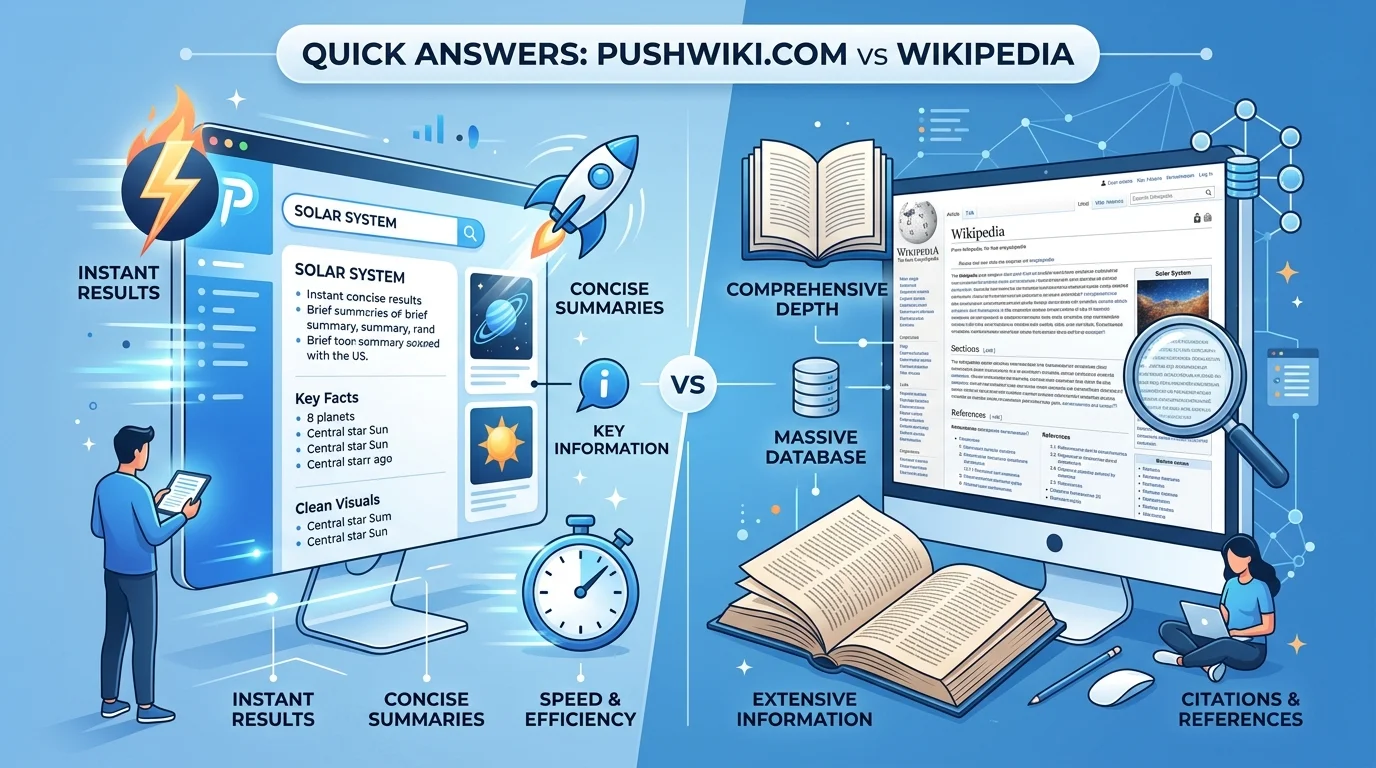
Searching for a quick answer online usually leads to one of two places: Wikipedia, the world’s largest free encyclopedia, or a smaller content site like PushWiki.com. They look similar, but they’re built very differently. Wikipedia runs on crowdsourced encyclopedia editing, open licensing, and a public citation trail that lets you check where its facts come from. PushWiki.com is a content platform written by a small team, closer to a blog than a wiki, despite the name. Understanding that difference matters more than picking a “winner.” This guide breaks down how each one handles fact-checking, speed, depth, and trustworthiness, so you know exactly where to look next time you need an answer fast.
If you’ve already compared other quick-answer sites, this is the same kind of question we tackled in FindRemind vs. Wikipedia: which gives better answers — the short version is that “encyclopedia vs. content platform” is a recurring theme across most of these lookup tools.
What Are PushWiki.com and Wikipedia?
Wikipedia is a free, crowdsourced encyclopedia run by the nonprofit Wikimedia Foundation. Anyone can propose an edit, every article carries a revision history, and the site currently holds more than 6.9 million English-language articles. It’s one of the most visited websites in the world, and it functions as a genuine primary source vs. secondary source reference point for millions of readers daily.
PushWiki.com is a different kind of website. Based on its own public description and independent reviews, it’s a content platform that publishes articles on topics like SEO, blogging, and digital marketing, written by a small internal team rather than an open community. It doesn’t use community-edited content, doesn’t carry an open license like Wikipedia’s, and doesn’t publish citations the way an encyclopedia does. That’s not a flaw. It just means it’s closer to a blog or digital magazine than to a wiki, despite the name.
For a deeper look at whether PushWiki.com holds up to scrutiny on its own, our full breakdown in Is PushWiki.com legit? 2026 review covers its ownership, content practices, and user trust signals in more detail.
How PushWiki.com and Wikipedia Are Built
Wikipedia runs on consensus-based editing. Registered and anonymous contributors write and revise articles together, disagreements get worked out on Talk page discussions, and unresolved conflicts can escalate to the Arbitration Committee, a body of elected volunteers who rule on serious editing disputes. Site moderators (called administrators) patrol recent changes, and bots flag likely vandalism within minutes on high-traffic pages.
PushWiki.com works more like traditional web publishing. A small team drafts and edits articles internally, which means faster turnaround and a consistent voice, but it also means there’s no public edit history, no open anonymous editing, and no community dispute-resolution process to check. If you’re deciding which model to trust for a specific claim, knowing this difference upfront saves you from comparing two things that were never built the same way.
If you want the full picture of what PushWiki.com actually publishes and how its content is organized, see PushWiki.com: complete guide to features and knowledge (2026).
Accuracy and Credibility: Which Source Can You Trust More?
Wikipedia’s biggest strength is transparency. Every claim is supposed to trace back to a citable source, articles flag when neutrality is disputed, and the site’s own source reliability guidelines rank outlets from generally reliable to deprecated. That said, Wikipedia is still not considered a peer-reviewed source, and lower-traffic articles can sit uncorrected for a long time. Teachers routinely tell students not to cite it directly for exactly this reason — not because it’s a non-credible source, but because an encyclopedia (any encyclopedia) is a starting point, not a primary reference.
PushWiki.com doesn’t publish the kind of sourcing trail that lets a reader independently verify claims the way Wikipedia’s citation system does. That makes it reasonable for general, low-stakes reading, but it’s not built for academic or research-grade use. If accuracy under scrutiny is what you need, Wikipedia’s open citation model — flawed as it can be — still gives you something to check. A blog-style site generally doesn’t.
We ran a similar credibility check on another quick-answer platform in Is FindRemind legit or a scam?, which is worth a look if you’re generally trying to figure out how to vet these smaller answer sites before trusting them.
Speed and Ease of Finding Quick Answers
For a fast lookup, both sites load quickly and work fine on mobile. Wikipedia’s mobile app and “quick facts” info boxes are built specifically to surface a short answer without forcing you to read the whole article, which makes it genuinely strong for quick answers to factual questions like dates, definitions, or basic biography.
If your question is “what year did X happen,” Wikipedia’s structure gets you there faster. Your question is “how do I do X,” a guide-style site like PushWiki.com can actually be more useful.
If you rely on Wikipedia often and want a faster reading experience without ads or clutter, our Wikiwand extension review (2026). Itcovers a tool built specifically to speed up that workflow.
Depth of Content: Quick Facts vs. In-Depth Coverage
Wikipedia’s depth comes from scale. Popular topics often have thousands of words, dozens of citations, and linked sub-articles for related concepts. Niche or breaking topics get thinner coverage until more contributors weigh in, which is a real limitation of the crowdsourced encyclopedia model.
PushWiki.com’s depth comes from focus instead of scale. Its content sits in a narrower set of categories, mostly digital marketing and web-related topics, and articles there are written as structured guides rather than reference entries. Neither approach is “more in-depth” across the board — it depends entirely on what you’re looking up.
Licensing and Copyright: Can You Reuse the Content?
Wikipedia text is published under the Creative Commons Attribution-ShareAlike license, and older content is also available under the GNU Free Documentation License (GFDL), a form of copyleft licensing. In practice, that means you can copy, adapt, and redistribute Wikipedia content — including commercially — as long as you credit the source and license your version the same way. This is why sites like Fandom wikis can legally reuse Wikipedia-style content: it’s genuinely open-source content.
PushWiki.com, like most standard blogs and content sites, operates under normal copyright by default unless it states otherwise on its own terms page. That means you generally can’t republish its articles without permission. If reusable, freely licensed content is what you need, Wikipedia’s licensing model is the one built for that purpose.
Community and Contributor Trustworthiness
Wikipedia’s trust model relies on numbers. Thousands of active editors watch high-traffic pages, and content moderation catches most bad edits within minutes to hours. It’s not perfect — smaller-language Wikipedias and low-traffic English articles have had real problems with unnoticed misinformation / disinformation, and editorial bias / ideological bias disputes are common on politically sensitive topics. Recent scrutiny, including public criticism from figures like Elon Musk and Wikipedia co-founder Larry Sanger, has focused on exactly this: whether Wikipedia’s sourcing lists and neutral point of view (NPOV) policy are applied consistently across contested subjects.
PushWiki.com sidesteps the open-editing risk simply by not being open-edited. There’s no vandalism to catch because there’s no public edit access, but that also means there’s no outside check on what the internal team publishes beyond their own editorial process. Trustworthiness here comes from a different source: a small, accountable team instead of a large, self-policing crowd.
If you’re weighing PushWiki.com against other small content platforms in this same category, sites like FindRemind rounds up a few comparable alternatives and how they each handle editorial trust.
PushWiki.com vs. Wikipedia: Head-to-Head Comparison Table
| Feature | PushWiki.com | Wikipedia |
|---|---|---|
| Content type | Blog-style guides and articles | Encyclopedia entries |
| Who writes it | Small internal team | Open community of volunteers |
| Editing access | Closed (staff-written) | Open (anyone can propose edits) |
| Citation system | Not published | Required, inline citations |
| Licensing | Standard copyright | CC BY-SA / GFDL (open license) |
| Best for | Guides, how-to explainers | Quick facts, general reference |
| Academic use | Not designed for citation | Not citable directly, but sources are |
Which One Should You Use for Quick Answers? (Final Verdict)
For a fast factual lookup — a date, a definition, a basic overview — Wikipedia remains the stronger tool because of its citation trail and open licensing. For a beginner-friendly walkthrough on a digital marketing or web topic, PushWiki.com’s guide format can be genuinely more readable. Neither one replaces the other, because they were never solving the same problem.
If your question requires a truly academic sourcing standard, though, neither site is the final stop. Use Wikipedia to find the primary sources cited at the bottom of the article, then go read those directly. That’s the same advice any teacher would give you, and it still holds up in 2026.
Frequently Asked Questions
Is Wikipedia left wing or right wing?
Wikipedia doesn’t have an official political stance, but critics across the spectrum have raised editorial bias / ideological bias concerns on contested topics, and this has become a bigger public debate recently, including congressional letters from lawmakers like Ted Cruz, James Comer, and Nancy Mace questioning the site’s neutrality.
Why do teachers say don’t use Wikipedia?
Because an encyclopedia — any encyclopedia — is a summary of other sources, not a primary source vs. secondary source itself, so teachers want you to read the original citations Wikipedia links to instead.
Why are wikis leaving Fandom?
Many independent wiki communities have moved off Fandom in recent years over concerns about intrusive ads, loss of editorial control, and disagreements with the platform’s monetization model, choosing to self-host instead.