Text to Speech Online Free Unlimited: Real Limits (2026)

Text to speech online free unlimited means browser-based speech synthesis, not a generous free tier. Tools that run on your own device using the Web Speech API have no per-character cost, so they impose no character caps. Cloud providers like Amazon Polly and Google Cloud charge per character and offer quotas instead, typically 500,000 to 5 million characters per month. Only a handful of free tools combine unlimited output, MP3 download, and full commercial rights. This guide compares the real limits behind each one, verified August 2026.
Now, the part nobody puts in a table.
I’ve burned a lot of hours hunting for free TTS tools that actually keep their promise.
Most don’t.
You paste 900 words, hit generate, and a popup asks for your credit card. Sound familiar?
So here’s what I did. I tested the popular options, dug into the pricing pages nobody reads, and figured out which claims hold up.
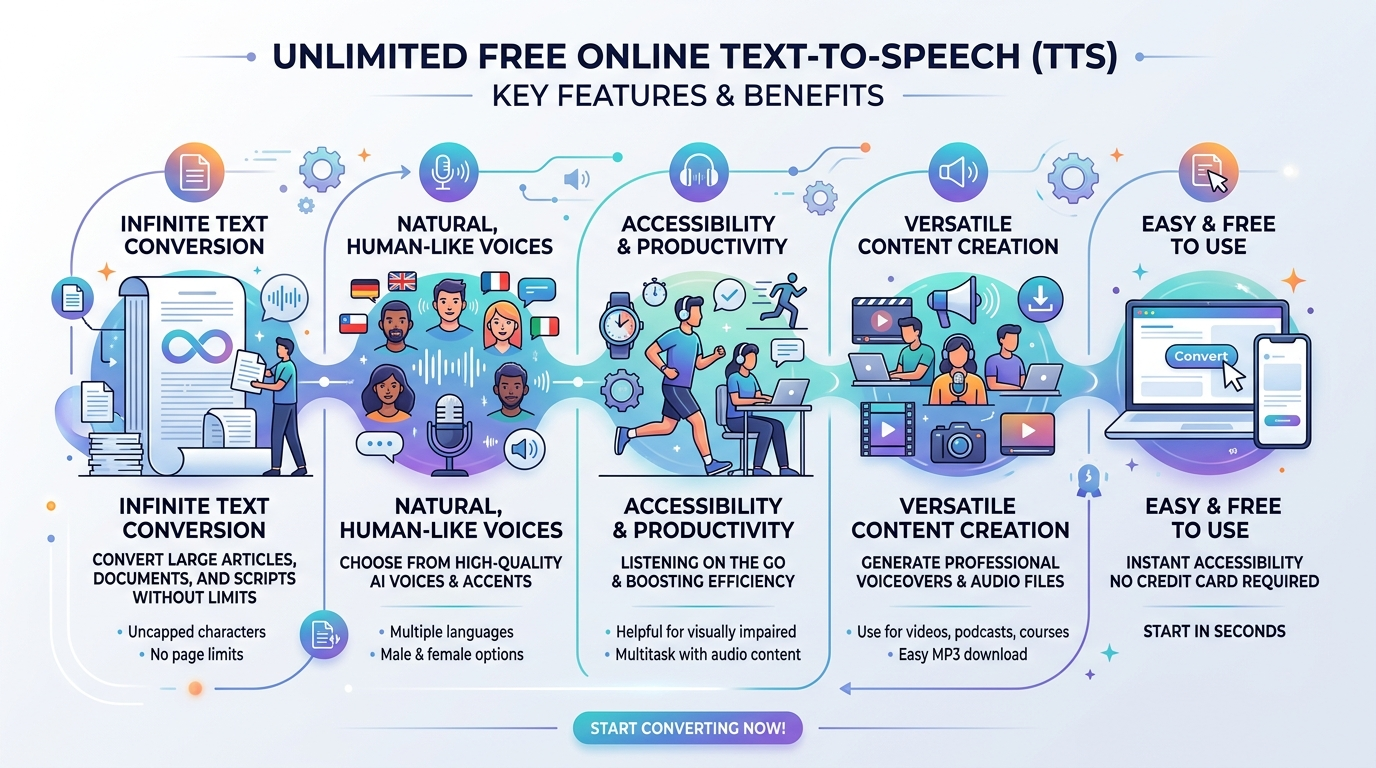
What “Unlimited” Actually Means in Free Text to Speech
Before you pick a tool, you need to understand why some services can afford to be free forever and others can’t. This one distinction saved me weeks of trial and error, and honestly, it’s the thing almost every roundup post skips. Once you see it, you’ll never get burned by a fake free tier again. There are two completely different kinds of “free” out there, and they behave nothing alike.
The first kind runs on your own machine.
Your browser already ships with a speech synthesis engine. Developers reach it through the SpeechSynthesis interface and the SpeechSynthesisUtterance object, which carries your text plus language, pitch, rate, and volume. Nothing gets sent to a server. Nobody pays per character. That’s why a browser based text to speech tool can genuinely offer unlimited characters without going bankrupt.
The second kind bills someone, somewhere.
Cloud providers charge per character. Amazon Polly’s pricing page spells it out: Standard voices run $4 per million characters, Neural voices $16. The free tier is real, but it expires after twelve months. That’s a quota, not unlimited.
Keep that split in your head. It explains everything that follows. If you want the plain-English version of how read-aloud technology works before you go further, our read out loud text guide covers the fundamentals.
The Free Tier Trap (And How I Dodge It)
I want to save you the frustration I went through, so let me lay out the actual numbers I verified against each provider’s own pricing documentation. Marketing pages love the word “free” and hate the word “until.” Every tool below is legitimately useful, but only some let you work at volume without a bill or a watermark showing up. Read this before you commit a project to any single platform.
| Provider | Free allowance | Expires? | Commercial use | MP3 download |
|---|---|---|---|---|
| Browser / device voices | Truly unlimited | ❌ No | ✅ Yes | Varies by tool |
| Google Cloud TTS | ~1M WaveNet chars/mo | ❌ Renews monthly | ✅ Yes | ✅ Yes |
| Amazon Polly | 5M standard chars/mo | ✅ After 12 months | ✅ Yes | ✅ Yes |
| Microsoft Azure F0 tier | ~500K neural chars/mo | ❌ No | ✅ Yes | ✅ Yes |
| ElevenLabs | 10,000 chars/mo | ❌ No | ❌ Attribution required | ✅ Yes |
Last verified: August 2026. Free tiers change often, so confirm on each provider’s pricing page before you build on it.
That last row matters more than people realize.
Ten thousand characters sounds generous until you write a ten-minute script. ElevenLabs’ own usage guidance puts 1,000 words of narration at roughly 6,500 to 7,000 characters, which means a single medium-length video eats most of your month. Our full ElevenLabs free voice generator guide breaks down exactly where that quota runs out.
And text to speech commercial use free is where the real trap sits. On the ElevenLabs free plan you must credit them, so monetized client work needs a paid tier. If you’re producing content for income, check the license before the voice, not after.
My Step-by-Step Process for Free Unlimited Voiceovers
Here’s the exact workflow I use when I need audio fast and refuse to pay for it. It takes about five minutes end to end, and it works whether you’re narrating a course module or dubbing a TikTok. Follow the order, because step two is where most people go wrong and end up regenerating everything an hour later.
Step 1: Clean Your Script First
Expand abbreviations. Spell out numbers you want read a specific way. Good text normalization on your end beats fighting the voice engine later.
Step 2: Pick Your Tool Based on Output, Not Vibes
Need a downloadable file? Go straight to a free text to speech download MP3 option like TTSReader or TTSMaker. Just listening? Any text to speech no sign up browser reader does the job. If you work in Hindi, Urdu, or other South Asian languages, our DesiVocal free AI voice generator review covers a stronger regional option.
Step 3: Choose a Neural Voice, Always
Older concatenative engines stitch recorded fragments together and sound it. Neural TTS models generate speech end to end, with far better prosody and intonation. The difference is obvious past thirty seconds. For a look at how far expressive AI audio has come, see our MiniMax Audio review.
Step 4: Tune Pitch and Speed
Most online voice generator free tools expose pitch and speed control. Drop the rate slightly for tutorials. Nudge it up for social clips.
Step 5: Add Pauses With SSML
SSML lets you insert breaks, emphasis, and phoneme corrections. It’s the single fastest upgrade to a robotic-sounding read.
Step 6: Export and Listen Once, Fully
Every single time. Mispronounced brand names hide in the last paragraph.
Free Text to Speech APIs for Developers
If you’re building text to speech into a product rather than generating one-off clips, the calculation changes completely. You’re no longer choosing a website. You’re choosing a billing model you’ll live with for years, and the free tiers differ far more than the marketing suggests. Here’s how the major free TTS API options actually compare on the things that bite you later.
Amazon Polly gives the biggest headline number, but the clock starts at your first API call, not account creation. It also offers speech marks for word-level timestamps, which matters if you’re building lip-sync or karaoke-style highlighting.
Google Cloud Text-to-Speech renews monthly and doesn’t expire, which makes it the stronger long-term free option. You’ll need billing enabled to activate it.
Microsoft Azure AI Speech ships the F0 tier with no expiry and very broad language coverage.
Open source models are the genuinely unlimited path. Piper runs locally, costs nothing, and has no quota at all. You trade convenience for control.
OpenAI’s TTS has no free tier. You pay from the first character.
Who Actually Needs This (Probably You)
I used to think text to voice generator free tools were a niche accessibility thing. Then I watched a friend cut her course production time in half with one, and I changed my mind completely. The audience is far wider than most people assume, and there’s a decent chance you fall into more than one bucket below.
Creators. A YouTube voiceover generator removes the mic, the room treatment, and the retakes. Same for a TikTok voice generator. Pair it with a YouTube video transcript generator and you can turn one script into audio, captions, and a blog post.
Educators. E-learning voiceover work scales beautifully here. Update a slide, regenerate the audio, done.
Publishers. Audiobook narration AI has gotten shockingly good for non-fiction.
Everyone building websites. This one’s not optional. The W3C Web Accessibility Initiative names three groups served by read-aloud technology: people who are blind, people with partial sight, and people with dyslexia and other cognitive or learning disabilities who benefit from hearing and seeing text together. WCAG 2.2 became a W3C Recommendation on 5 October 2023, adding nine success criteria to the existing POUR framework. A read aloud tool for dyslexia helps you meet those standards while genuinely helping people.
That’s not a compliance checkbox. That’s a bigger audience.
A Quick Note on Multilingual Work
Multilingual text to speech is where free tools separate themselves. Some cover five languages. Others cover seventy-plus with regional accents. If you publish in more than one language, test your target language specifically, because English quality tells you nothing about Urdu or Vietnamese output.
Frequently Asked Questions
Below are the questions I get asked most about free TTS online, answered in a sentence or two each so you can skim. If your question isn’t here, the comparison table above covers most of the remaining edge cases.
Is there a text to speech tool that is genuinely free and unlimited?
Yes. Browser-based tools using device voices have no character cap because synthesis happens locally. Cloud-based tools always have a quota.
Can I use free text to speech audio commercially?
It depends on the provider. Amazon Polly and Google Cloud permit commercial use on their free tiers. ElevenLabs’ free plan requires attribution and does not include a commercial license.
Which free TTS has no character limit?
Browser-native readers like TTSReader, plus self-hosted open source models like Piper. Metered cloud APIs all impose limits.
Do I need to sign up to use text to speech online?
No. Several tools including TTSMaker and TTSReader work without registration.
Can I download the audio as MP3?
Most dedicated TTS websites offer MP3 export. Pure browser-playback readers sometimes don’t, so check before you write your script.
Why do some free tools add a watermark or require attribution?
Because generation costs them money. Attribution is how free tiers on premium platforms recover that cost.
Why I Recommend Starting Free Today
You lose nothing by testing, and the market is moving fast enough that waiting costs you. Analyst estimates for 2026 vary widely: Global Market Insights puts the sector near $5.7 billion growing at 22.4%, while Polaris Market Research estimates roughly $4.1 billion at 3.7%. That disagreement is itself the useful signal. Nobody knows how fast this grows, but everybody agrees it’s growing.
So here’s my honest advice.
Start with a text to speech online free unlimited browser tool this afternoon. Run one real script through it. If the quality clears your bar, you’ve eliminated a recurring cost from your workflow permanently.
If it doesn’t clear your bar, you now know exactly what you’re paying to fix, and a $5 tier with full commercial rights suddenly looks like the best money you’ll spend this quarter.
Either way, you win.
Ready to pick one? Browse the full voice and audio AI tools directory and start generating today.